

Contents
Demo Link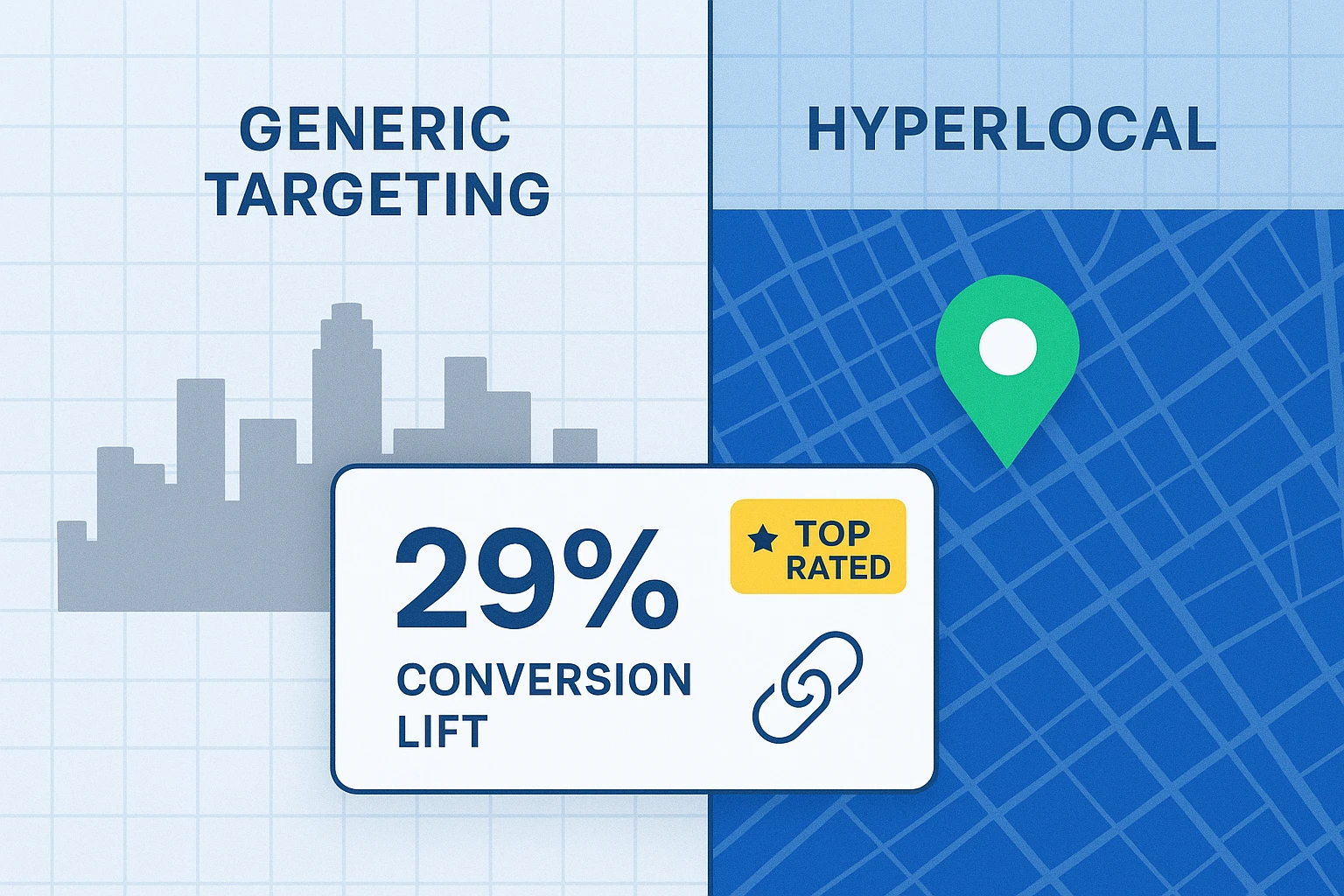
For years, the playbook for local SEO was simple: take your core service, append a city name, and publish. If you were an agency in Chicago, you ranked for "SEO Agency Chicago." If you were a plumber in Manchester, you targeted "Plumber Manchester."
That playbook is now the bare minimum. The search landscape has shifted fundamentally from broad city targeting to Hyperlocal Entity & Intent Mapping. Success in the coming years won’t be defined by ranking for "City + Service," but by dominating specific combinations of "Micro-Neighborhood + Intent Modifier + Entity."
If you are a marketing director or agency owner evaluating how to break through a stagnant local plateau, you likely know that generic keyword lists are yielding diminishing returns. The volume is there, but the conversion isn't.
This guide outlines a strategic framework to bridge the gap between high-level market analysis and the granular, street-level reality of how users actually search today.
The data is clear regarding user behavior: generic local searches are becoming research phases, while specific, hyperlocal searches are decision phases.
According to Soci.ai, hyperlocal searches involving site-specific landmarks or neighborhood names drive 29% higher conversions than broad local terms. Why? Because the intent is crystallized. A user searching for "coffee shop downtown near the train station" has a significantly higher immediate purchase intent than someone searching "coffee shops [City Name]."
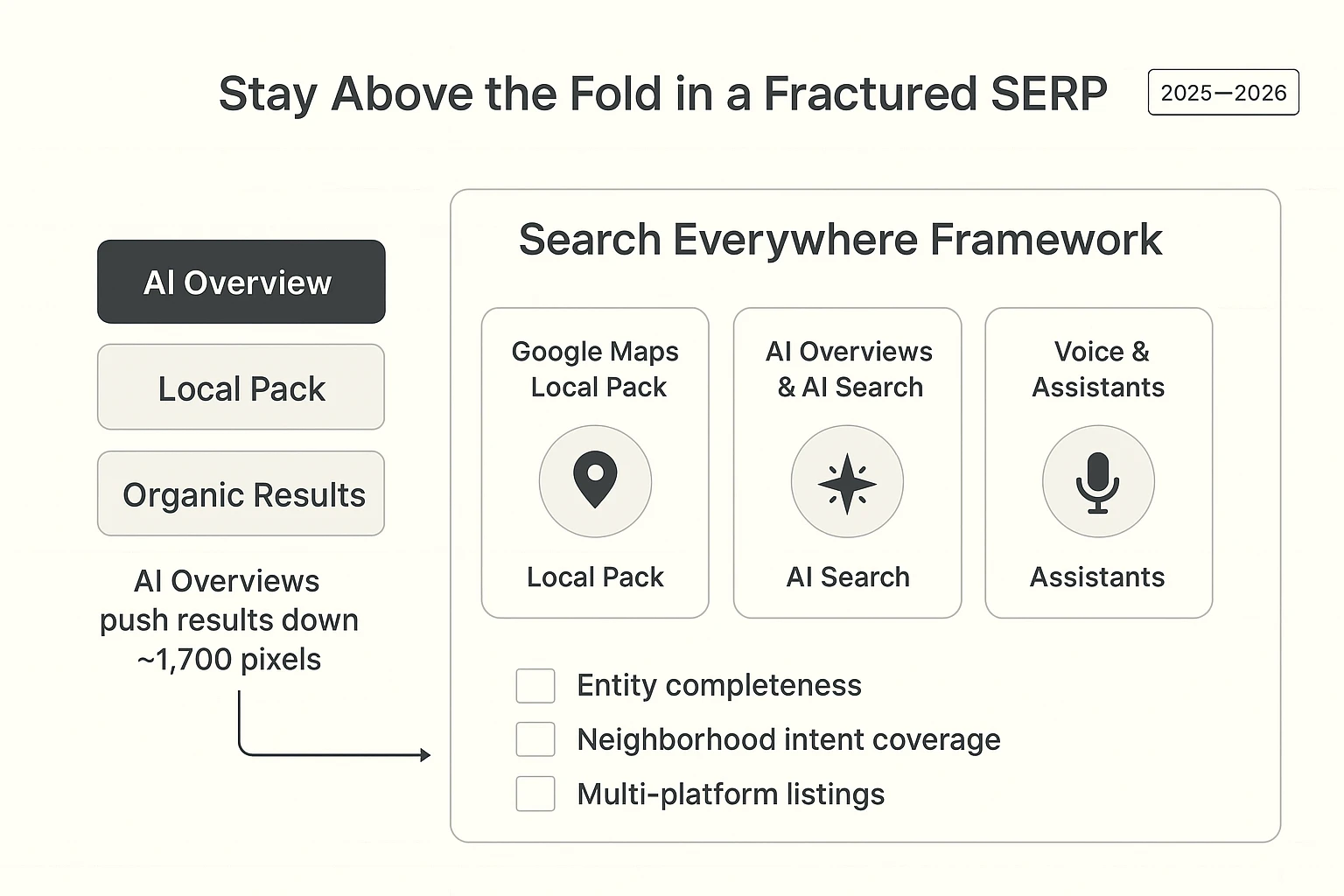
This shift requires us to move from a list of keywords to an Intent-Entity Framework. Google’s algorithms (BERT and MUM) now prioritize the relationships between entities. To capture the AI Overview (Position Zero) and the Local Pack simultaneously, your content must map your service not just to a city, but to the specific landmarks, problems, and questions relevant to that micro-geography.
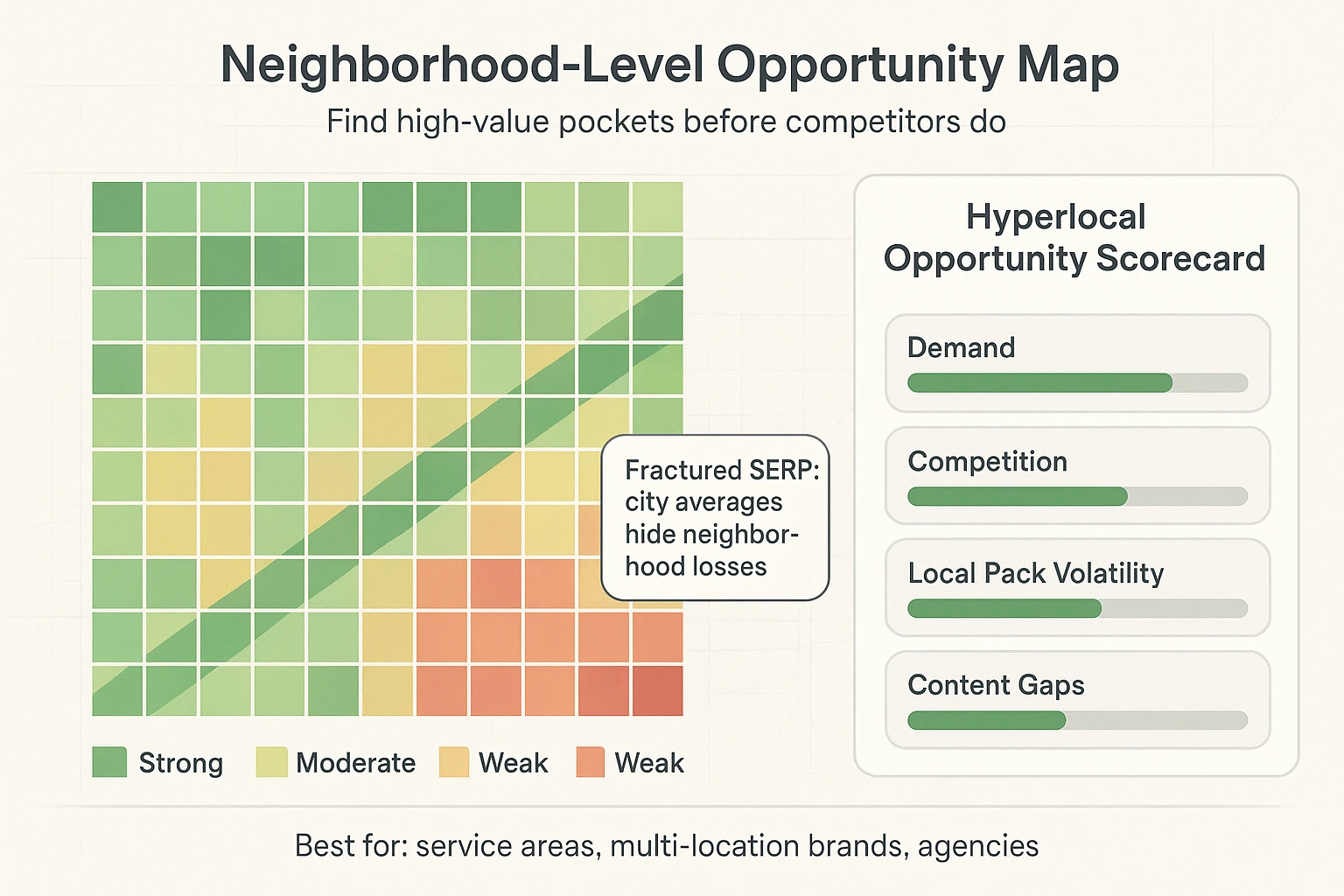
To capitalize on this, you need more than just citations. You need a strategy that identifies the best backlinks for local seo that reinforce these hyperlocal signals, proving to Google that you are the authority in that specific pocket of the map.
Most keyword research tools stop at volume. To build a strategy that outperforms incumbents, we need to classify keywords by their "Decision Factors"—urgency, pricing sensitivity, and specialized need.
We categorize local intent into three buckets:
The mistake most brands make is treating these all the same. A true seo-driven content marketing plan creates distinct assets for each. The "Research Mode" user needs a guide; the "Panic Mode" user needs a click-to-call button.
How do you actually find these opportunities? Most competitors rely on surface-level data. Here is a methodology for uncovering the "Intent Pockets" others miss.
Start with your broad service area, then drill down using "Intent Modifiers." These are words that signal a specific stage of the buyer's journey.
Use Conversational AI to map geographic intent differently than traditional tools. Ask questions like: “What are the top 3 complaints homeowners in [Neighborhood] have about [Service]?” or “What landmarks do locals in [Zip Code] use as navigation points?”
This allows you to optimize your H2 and H3 tags as natural language questions, which is the primary trigger for appearing in Google’s AI Overviews.
Finally, link your services to the physical reality of the location. This involves creating a robust link pyramid where your content references specific neighborhood entities (schools, parks, transit hubs).
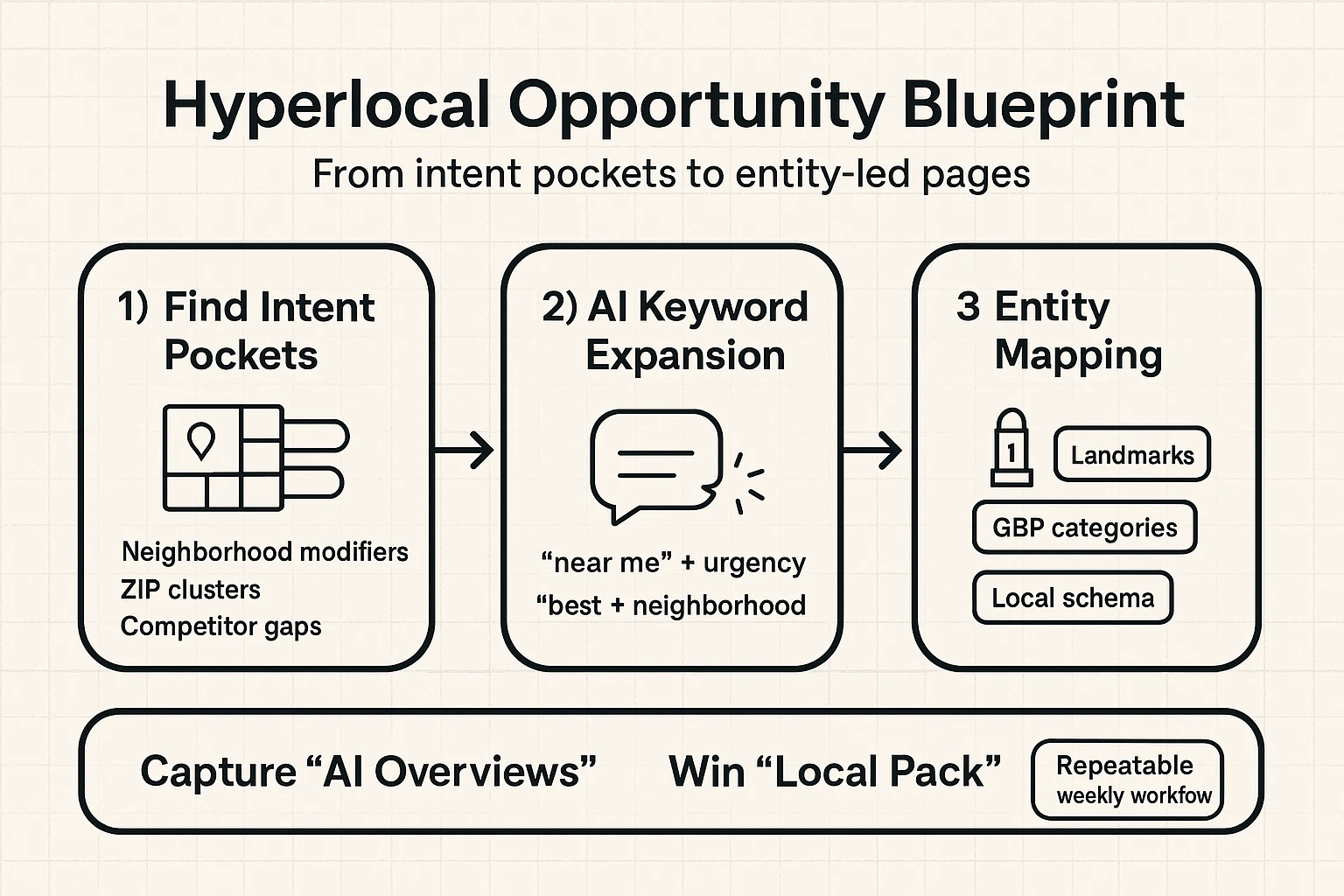
This manual mapping is effective, but scaling it requires sophistication. This is where automated link building combined with strict quality assurance (like our 18-point checklist) ensures you can build authority across multiple micro-locations without sacrificing quality.
When you present a hyperlocal strategy to stakeholders, the first pushback is often regarding volume. "Why target a keyword with only 20 searches a month?"
The answer lies in Decision Velocity. Data from Think with Google indicates that 76% of smartphone local searchers visit a business within 24 hours, and 28% purchase.
Broad keywords are vanity metrics. Hyperlocal keywords are revenue metrics.
If you are a large organization managing hundreds of locations, this granularity can seem daunting. An enterprise seo audit can help identify which locations have the highest "Entity Authority" and which are invisible, allowing you to prioritize your rollout effectively.
To illustrate the power of this mapping, look at specific high-value verticals:
Instead of targeting "sell my house," which puts you in competition with Zillow, effective mapping targets "probate sale [Zip Code]" or "avoid foreclosure [Neighborhood]." These terms have lower CPC and significantly higher intent from motivated sellers.
For retail, the battle is often won on mobile. If your mobile seo checklist doesn't include specific schema markup for "In Stock" inventory combined with neighborhood targeting, you are handing sales to Amazon.
As you evaluate partners or tools to execute this strategy, transparency is key. The market is flooded with low-quality "map pack" boosters that use spammy tactics.
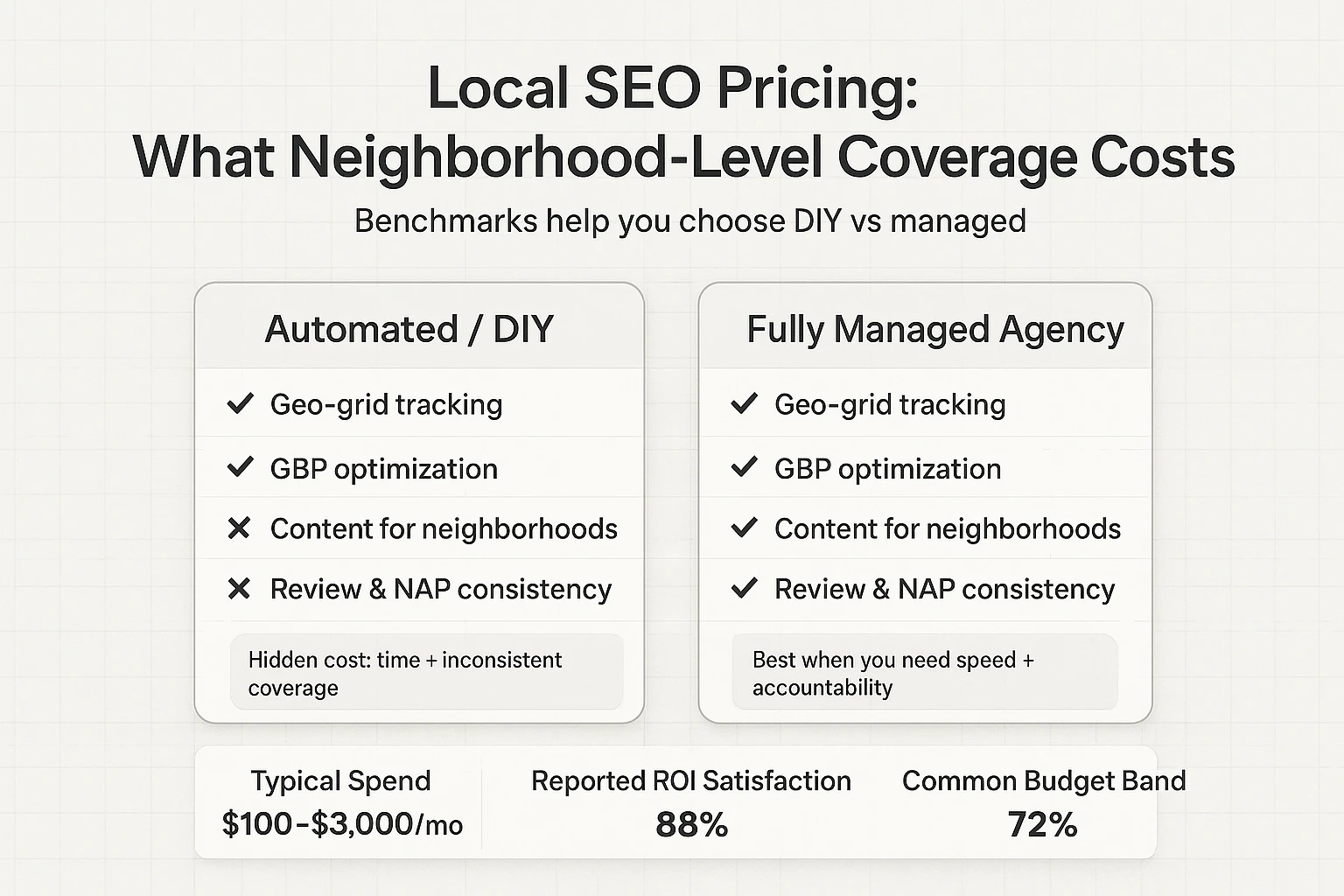
A legitimate strategy requires investment in content, schema, and high-quality backlinks. Current market benchmarks suggest that professional Google Business Profile (GBP) management ranges from $125 to $400/month per profile, with setup fees often between $300-$500.
If you are an agency looking to white-label these services, finding reliable link building services for seo agencies is critical to maintaining margins while delivering the depth of service described above.
Yes. The conversion rate on terms like "emergency plumber [Neighborhood]" is often 5x-10x higher than broad city terms. You are trading volume for revenue.
AI doesn't just find keywords; it helps map the intent behind them. Tools like ChatGPT can simulate local user personas to reveal questions and concerns specific to a demographic, which you can then answer in your content.
You can automate the structure and data gathering, but the final output requires human review. Spamming hundreds of neighborhood pages with identical content (changing only the city name) triggers "Doorway Page" penalties. The content must offer unique value relevant to that specific area.
The era of easy local wins is over. Dominating the SERPs in 2025 requiring thinking less like a keyword stuffer and more like a local guide. By mapping your opportunities at the entity level and supporting them with high-quality, trusted backlinks, you build a defensive moat that competitors cannot easily cross.
Whether you are building this in-house or looking for a strategic partner, prioritize depth over breadth. In the world of hyperlocal SEO, the specialist always beats the generalist.
