Contents
Demo Link
Imagine spending hours crafting the perfect piece of content, securing a backlink from a highly-trafficked site, and waiting for the traffic to roll in—only to realize search engines are completely ignoring the connection.
If this has happened to you recently, you aren't alone.
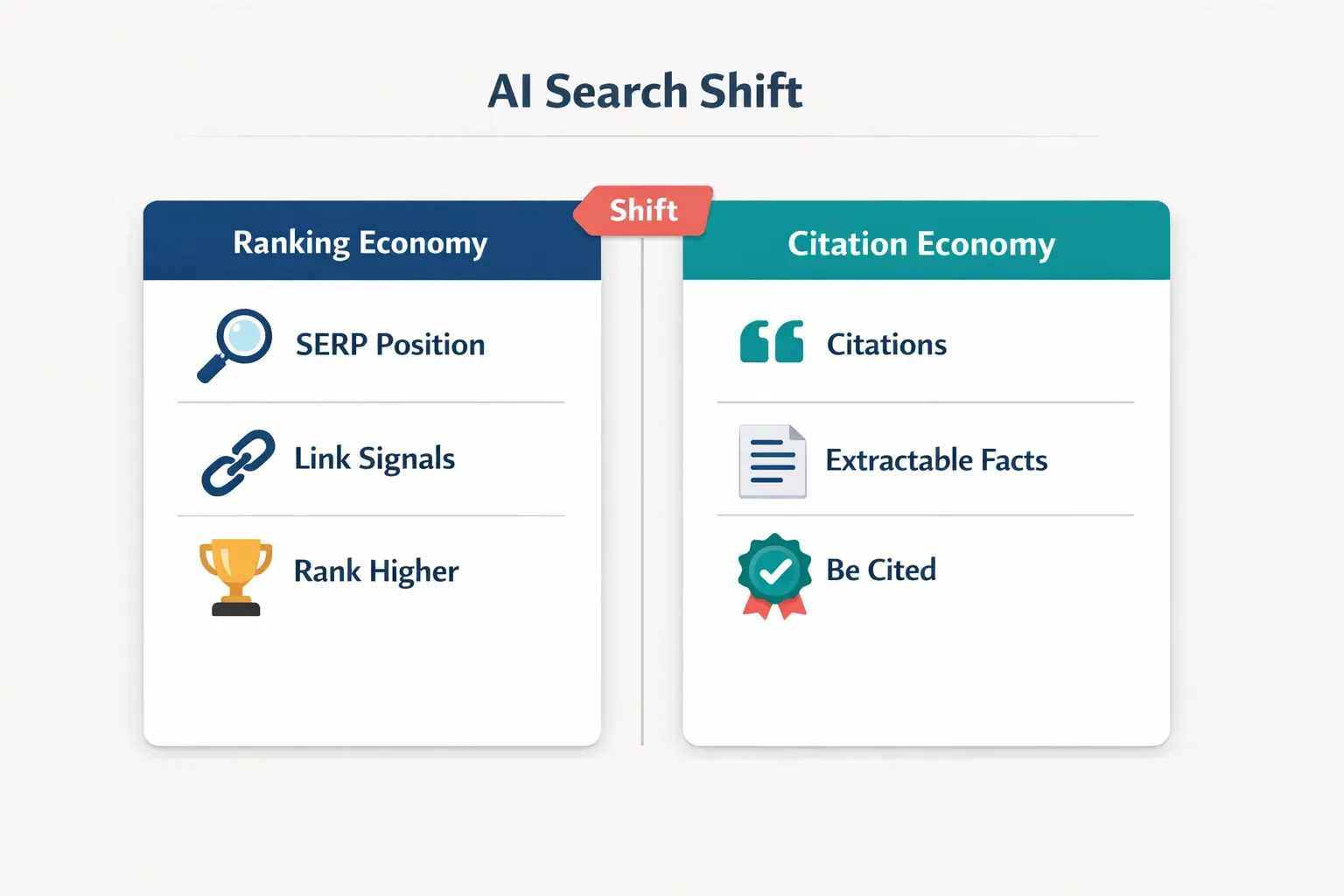
As we navigate the digital landscape of 2026, we are witnessing a fundamental shift in how the internet operates. We have transitioned from a traditional "Ranking Economy," where search engines tallied up links like votes in a popularity contest, to a "Citation Economy." Today's Large Language Models (LLMs) powering Google AI Overviews, Perplexity, and ChatGPT Search don't just count links; they read, comprehend, and cite them.
This requires a massive shift in how we think about link building. It’s no longer about mere keyword overlap. It’s about Semantic Alignment AI—the advanced natural language processing (NLP) techniques AI employs to assess the true topical fit between two pieces of content.
Let's dive into how AI actually "reads" your backlinks and how you can ensure your content becomes the definitive, citation-worthy resource in your industry.
In the early days of SEO, relevance was straightforward. If Site A sold "organic dog food" and Site B wrote a blog post mentioning "organic dog food" and linked back to Site A, the search engine saw a match. It was binary: the keywords matched, so the link was relevant.
However, language is messy. Words have multiple meanings, context shifts, and intent matters.
Semantic Alignment AI solves this by looking beyond the characters on the screen. Instead of asking, "Do these pages use the same words?" AI asks, "Do these pages discuss conceptually related entities in a way that provides value to the reader?"
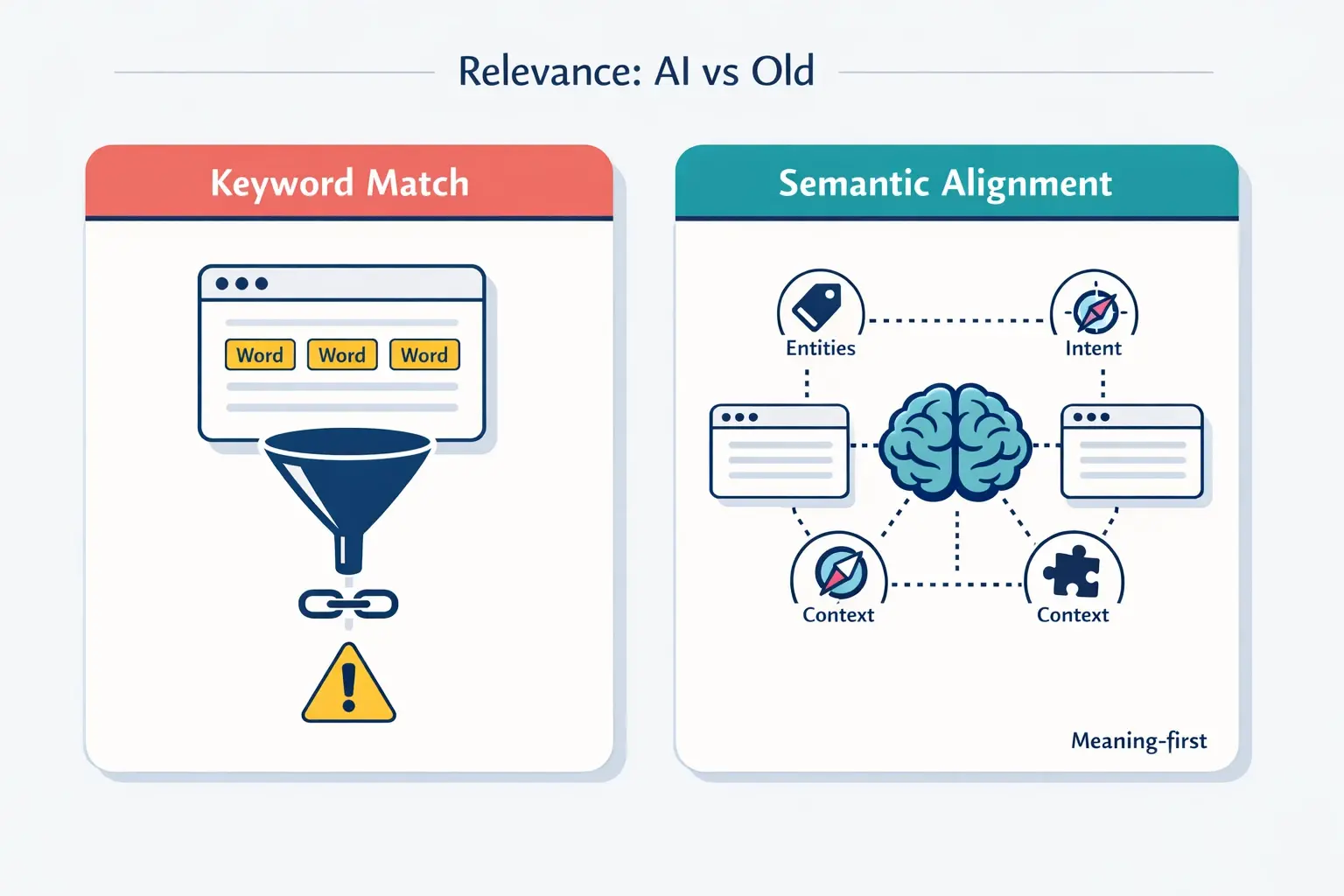
For example, an article about "Apple's new market cap" linking to an orchard's website using the anchor text "Apple growth" might pass a primitive keyword check. But Semantic AI immediately recognizes the contextual disconnect between corporate finance and agriculture. The link is devalued instantly.
To truly master backlink acquisition in 2026, it helps to understand the "science" of how AI evaluates a link. You don't need a degree in computer science, but knowing a few core concepts will change how you view your website.
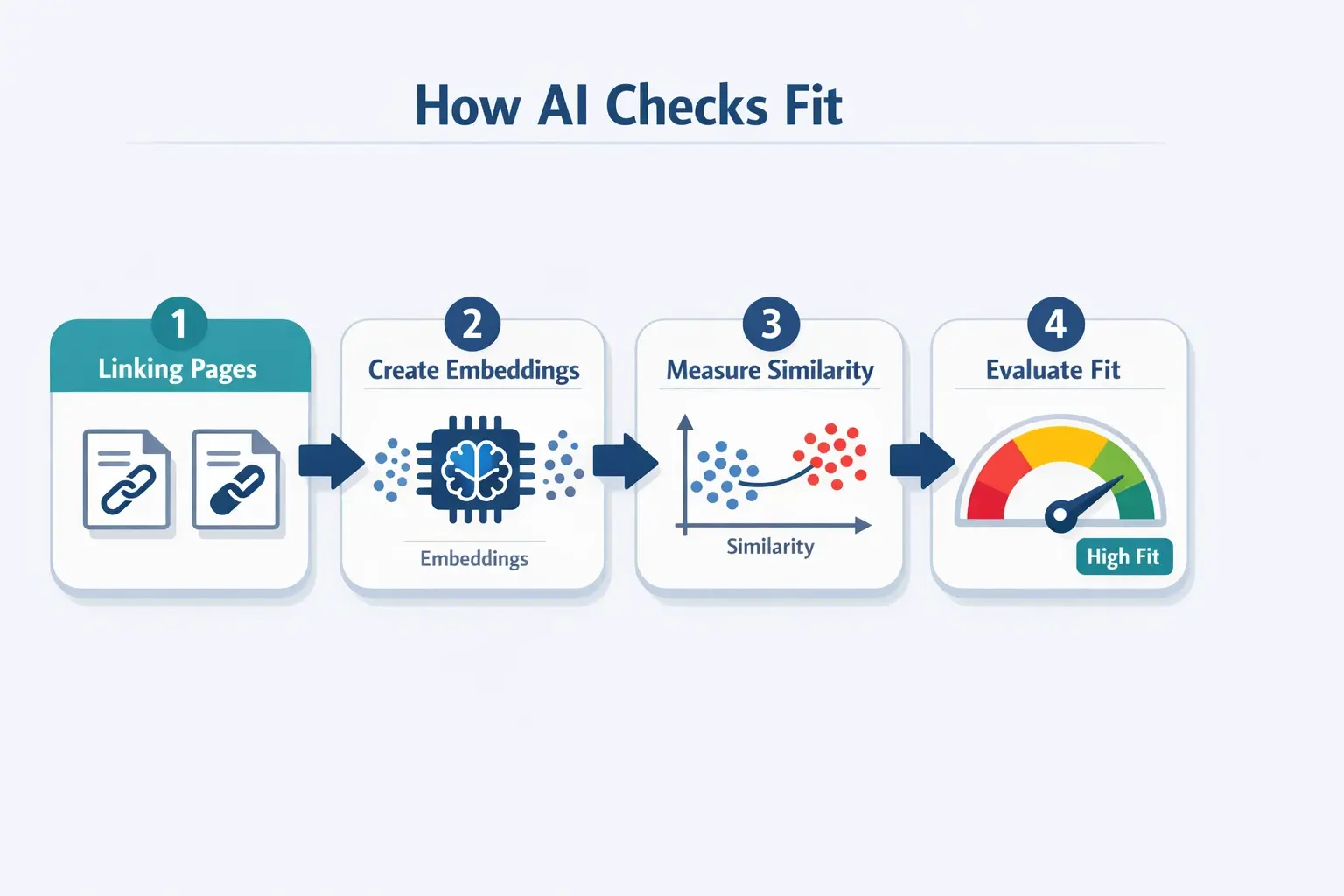
Think of an "embedding" as a massive, multi-dimensional map of meaning. AI models translate paragraphs of text into mathematical vectors (coordinates on this map). Words and concepts that share similar meanings group closely together on this map. When assessing a backlink, the AI plots the linking page and the destination page. The closer they are on the conceptual map (measured by a process called cosine similarity), the higher the semantic relevance.
AI doesn't read words; it identifies "entities"—people, places, concepts, and organizations. When a high-quality site links to you, AI evaluates if your site is a recognized authority on the entities discussed. If you've spent years building content around "fintech software," AI recognizes your brand as an entity associated with that topic.
AI evaluates the surrounding text of a link to gauge the author's intent. Is the link provided as a citation for a statistic? Is it a recommendation? Because AI relies heavily on Experience, Expertise, Authoritativeness, and Trustworthiness (E-E-A-T), traditional link metrics have evolved. A link from a highly relevant, deeply researched article on a smaller site often carries more semantic weight than a randomly placed link on a massive, generalized news site.
With AI answering user questions directly within the search interface, a common question arises: Do backlinks still matter in AI search?
Data from recent large-scale SEO studies confirms a resounding yes, but with a crucial caveat. Links are no longer just "ranking juice"; they are trust signals for citations.
When an LLM formulates an answer, it needs to verify its information against trusted sources to avoid "hallucinations" (making things up). Earning natural backlinks from topically aligned sites signals to the AI that your content is the consensus truth in your industry. In the citation economy, page authority isn't just about how high you rank on a list of ten blue links—it's about whether the AI trusts you enough to feature your insights directly in its generated answers.
Understanding how AI thinks is only half the battle. How do you actually build a link profile that AI loves?
AI models are greedy for structured, easy-to-digest data. If you want a referring site (or an AI search engine) to cite your work, make it effortless.
Before AI can trust external sites linking to you, it must understand the semantic relationships within your own site. Strategic internal link building creates a topical map for AI crawlers, reinforcing your authority on specific subjects.
If an AI bot can't efficiently crawl and render your page, your semantic brilliance is wasted. Utilizing an onpage seo checklist ensures that foundational elements like Server-Side Rendering (SSR), Core Web Vitals, and proper Schema markup (like FAQPage or Article schema) are in place. Schema is essentially speaking AI's native language, handing it your entities on a silver platter.
Transitioning to an AI-first backlink strategy requires taking stock of where you currently stand.
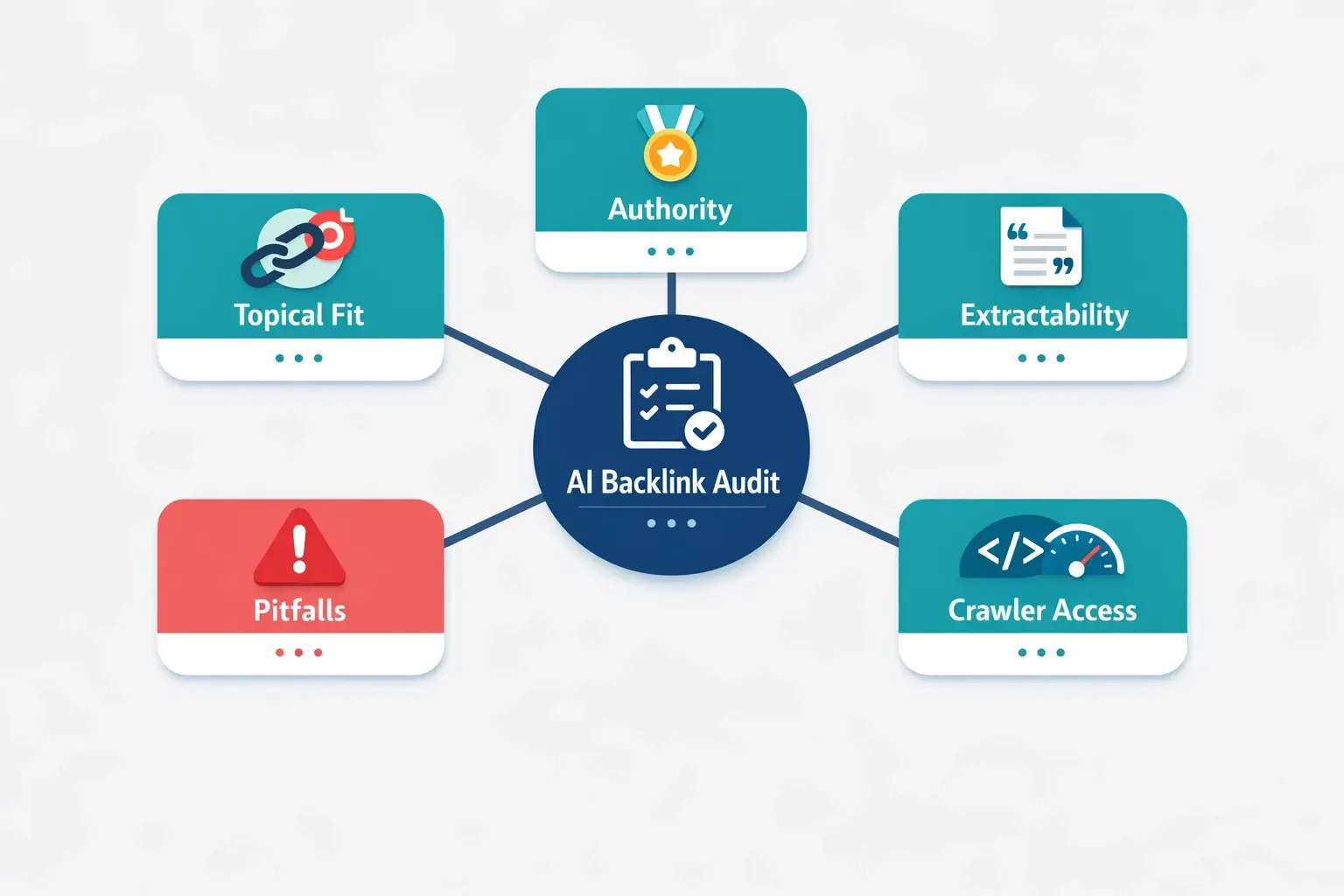
Start by evaluating your highest-value pages. Look at the incoming links: Are they from topically adjacent sites? Does the surrounding text provide meaningful context, or does it feel forced? Figuring out how to manage your backlinks through a semantic lens means prioritizing quality, relevance, and context over sheer volume. For larger organizations with thousands of pages, running a comprehensive enterprise seo audit focused on semantic alignment is often the first step to uncovering massive, hidden growth opportunities.
Semantic alignment AI refers to the advanced natural language processing (NLP) models search engines use to understand the meaning, context, and relationship between a linking page and a destination page. It moves beyond checking for matching keywords to ensure both pages genuinely discuss related entities and topics.
Absolutely. While the days of manipulating rankings with spammy links are gone, high-quality, semantically aligned backlinks serve as vital "trust signals" for AI. They prove to Large Language Models that your content is verified and trusted by other authorities, increasing your chances of being directly cited in AI Overviews.
A major pitfall is over-automating content and outreach without human editorial judgment, which can lead to "AI hallucinations" (generating plausible but false information) or losing personal connection in outreach. Another is focusing entirely on new AI metrics while ignoring technical accessibility (like rendering and schema), meaning AI bots can't even read the content you've optimized.
Instead of just tracking keyword positions, AI visibility is measured by "Share of Voice" within AI-generated answers (like Perplexity or Google AI Overviews). You track how often your brand or specific content is explicitly cited as a source when users ask natural language questions related to your core entities.
As we progress through 2026, the gap between traditional SEO tactics and AI-first strategies will only widen. Search engines will continue to refine their semantic understanding, rewarding brands that focus on deep, verifiable expertise and genuine topical alignment.
By understanding how Semantic Alignment AI assesses relevance, you stop chasing algorithms and start building an authoritative web presence that both human readers and AI systems inherently trust.