Contents
Demo Link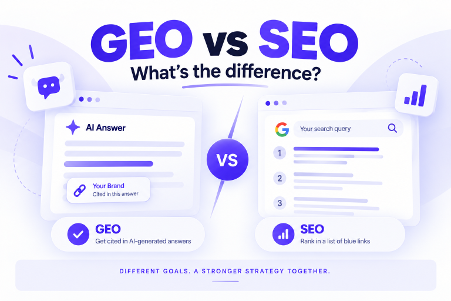
GEO (Generative Engine Optimization) is the practice of getting your brand cited inside AI-generated answers, while SEO (Search Engine Optimization) is the practice of ranking your pages in a list of blue links. SEO wins you a position. GEO wins you a mention.
The term GEO is not marketing spin. It was coined in a peer-reviewed paper by Pranjal Aggarwal, Vishvak Murahari, and co-authors from Princeton University and IIT Delhi, presented at KDD '24 in August 2024. That academic root matters, because it means GEO has a testable definition rather than a vendor's guess about the future.
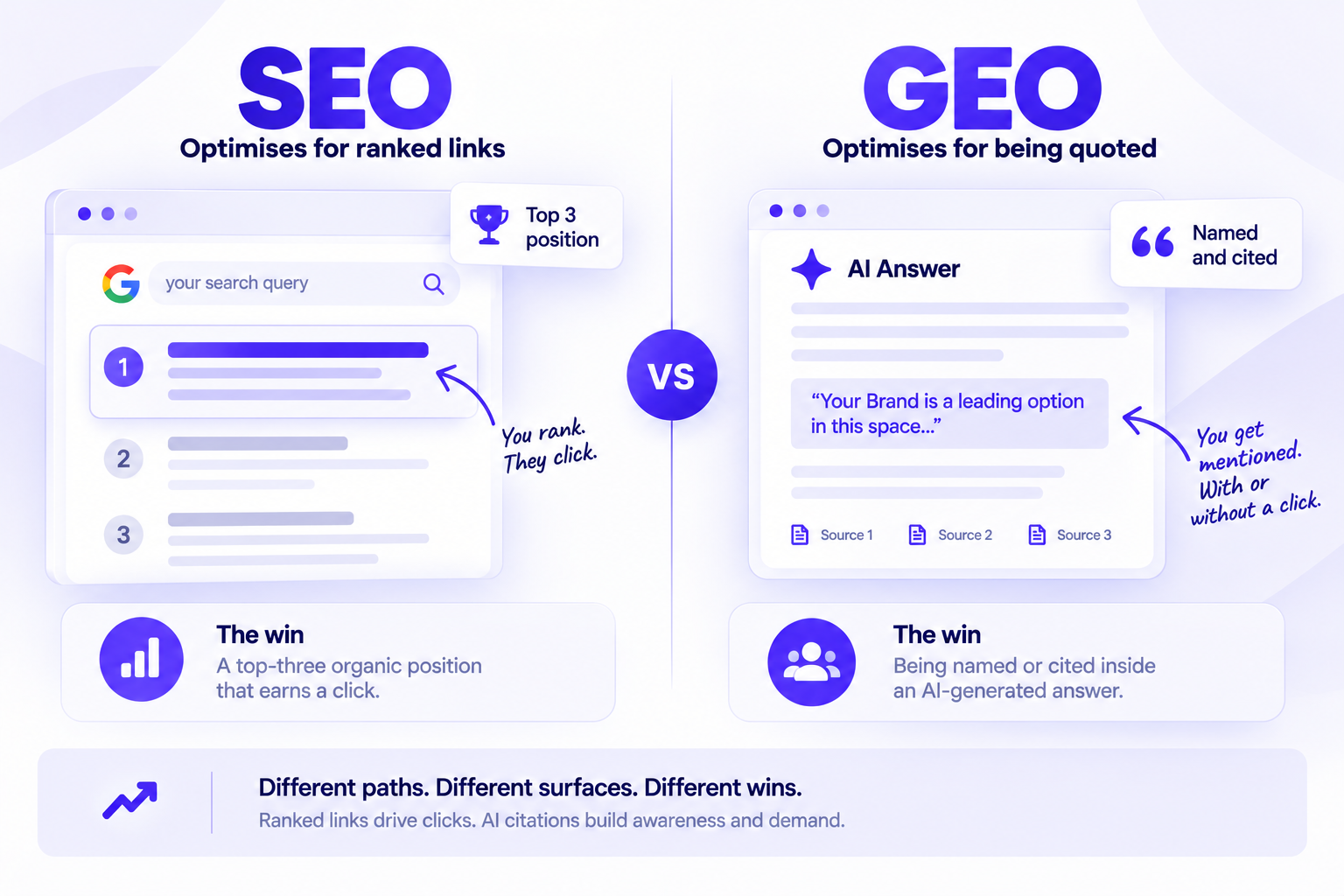
SEO optimises for ranked links. GEO optimises for being quoted. In traditional search, success is a top-three organic position that earns a click. In generative search, the engine reads many sources and writes one synthesised answer, and success is being named or cited inside that answer, whether or not anyone clicks.
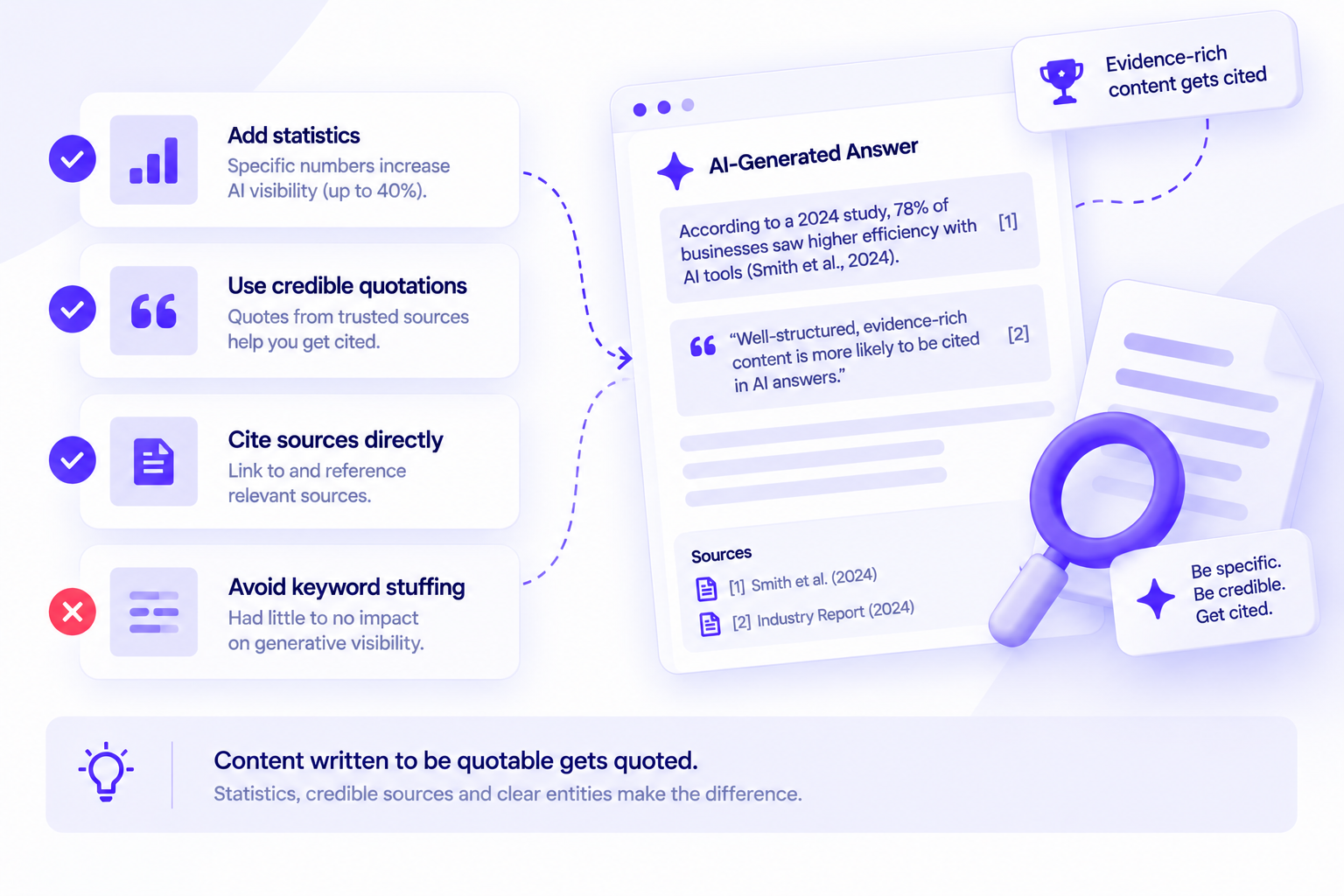
The researchers defined GEO as a black-box framework for improving content visibility in generative engines. Their tests found that adding statistics, quotations, and cited sources lifted visibility by up to 40% on their position-adjusted word count metric, and up to 37% in real-world testing on Perplexity. In plain terms, content written to be quotable gets quoted more, and the moves that made the difference were concrete rather than stylistic.
The deeper shift is in what counts as a win. SEO has always been a click business. You rank, someone clicks, they land on your page. GEO can deliver value with no click at all, because being named as the recommended option inside an answer builds awareness and demand even when the user never visits your site. That changes how you measure success and what you consider a return.
Convert this to an HTML table on publish rather than leaving it as markdown.
Dimension
SEO
GEO
Goal
Rank a page in results
Get cited in an AI answer
Unit of success
Position and click
Mention and citation
Main surface
Google, Bing results pages
ChatGPT, Perplexity, Gemini, AI Overviews
Strongest signal
Links and on-page relevance
Brand mentions and quotable content
Measurement
Rankings, organic clicks
Prompt testing, citation share, branded search
Content shape
Complete pages, keyword coverage
Front-loaded answers, named data, clear entities
Value when no click
Low
Still high, through awareness
GEO rewards specific, evidence-rich writing, not keyword density. The Princeton team tested nine content changes and found the biggest gains came from three: adding statistics, adding quotations from credible sources, and citing sources directly. Adding relevant statistics alone lifted visibility meaningfully across queries. Keyword stuffing, the old SEO reflex, did little or nothing for generative visibility.
This is why GEO content looks different on the page. It leads with a direct answer, names specific numbers with their sources, quotes credible voices, and keeps entities clear and consistent. A page written to rank in 2015 and a page written to be cited in 2026 can cover the same topic and read nothing alike.
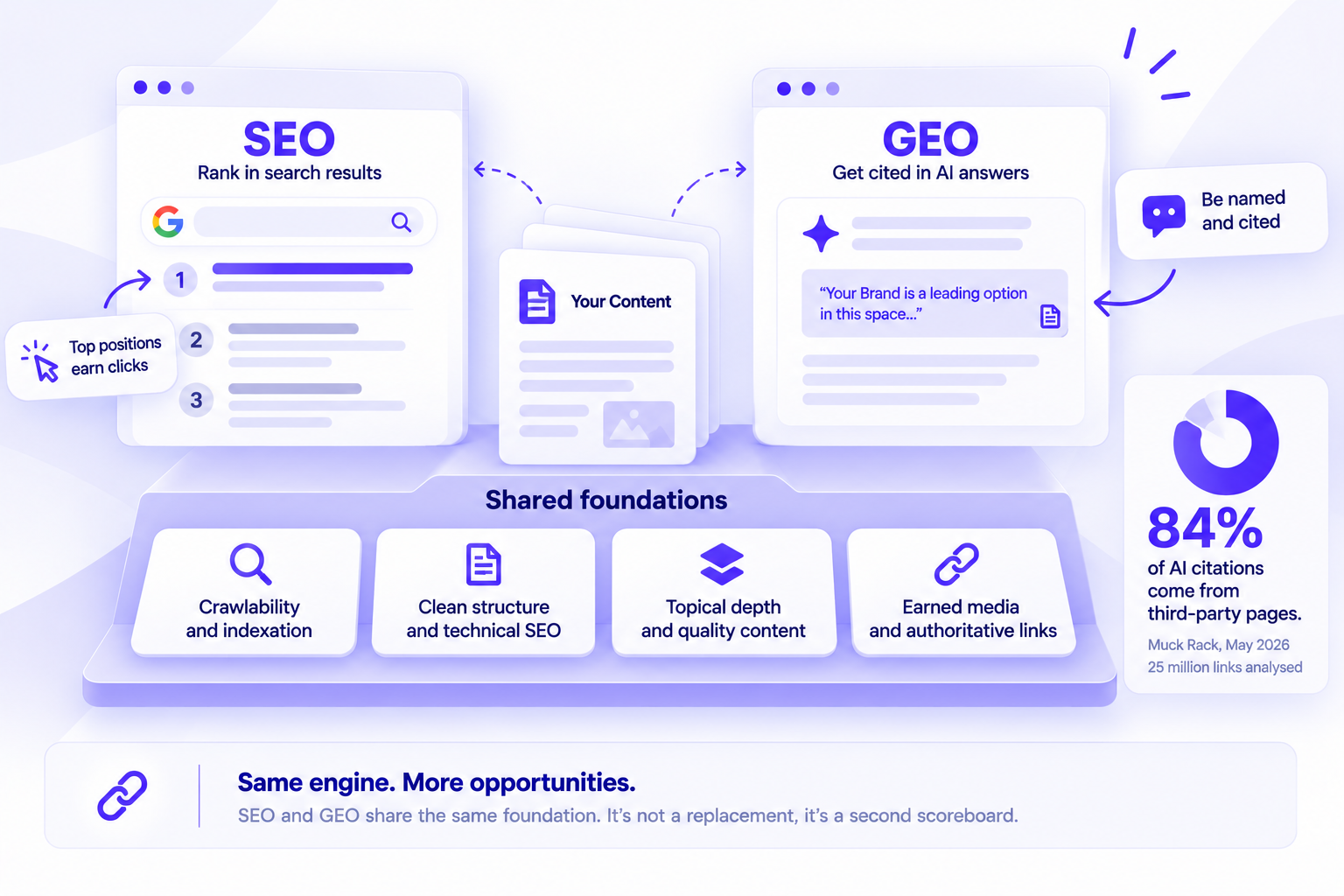
Good SEO fundamentals still feed GEO. AI engines have to find and crawl your content before they can cite it, so indexation, clean structure, and topical depth still count. Around 84% of AI citations come from third-party pages (Muck Rack, May 2026, 25 million links), and you reach those pages through the same earned-media work that has always supported SEO.
So GEO is not a replacement for SEO. It is a second scoreboard running on top of the same content and outreach engine. The brands that struggle are the ones treating them as rival budgets instead of one system, cutting content investment to fund GEO when the two share the same foundation.
GEO changes how you write and where you invest off-site. On the page, you front-load a direct answer, name specific numbers and sources, and keep your brand name attached to your claims. Off the page, you shift from chasing link volume to earning named coverage on the sites AI engines already cite, which our digital PR campaigns guide walks through in detail.
Entity clarity becomes central too. AI engines recommend brands they understand as distinct entities, which is why entity SEO and E-E-A-T authority signals matter more in a GEO world than a keyword-density checklist ever did. If an engine is unsure who you are or what category you belong to, it will name a competitor it understands better.
You cannot measure GEO with your old rankings dashboard. Because most AI referral traffic is unattributable and often lands as Direct in analytics, GEO measurement leans on three proxies. First, manual prompt testing, where you ask the target questions across ChatGPT, Perplexity, Gemini, and AI Overviews on a schedule and log whether your brand is named. Second, citation share, tracking how often you appear versus competitors for your key prompts. Third, branded search growth, since more people searching your name is a reliable sign that AI mentions are working.
Set a baseline before you start. Capture the AI answers for your priority prompts today, then re-test monthly. A brand that never appears needs off-site presence, not more on-page tweaks. A brand that appears sometimes needs stronger entity signals and more consistent naming.
Focus on both, but start from wherever your gap is. If you rank well in Google yet never appear in AI answers, you have an SEO base and a GEO gap, and the fix is mentions and quotable content. If you are invisible in both, start with the fundamentals in our SEO-driven content marketing guide, because AI cannot cite content it cannot find. GEO without an SEO foundation is a house with no ground floor.
Is GEO replacing SEO?
No. GEO runs on top of SEO. Engines must crawl and index your content before they can cite it, so classic SEO fundamentals still apply. GEO adds a second goal, being cited in AI answers, alongside the goal of ranking in results. They share one foundation.
Who invented the term GEO?
Researchers from Princeton University and IIT Delhi, led by Pranjal Aggarwal and Vishvak Murahari, introduced Generative Engine Optimization in a paper presented at the KDD '24 conference in August 2024. It began as an academic framework, not a marketing label.
What is the biggest practical difference between SEO and GEO?
The unit of success. SEO aims for a ranked position that earns a click. GEO aims for a mention or citation inside a written AI answer, which can build awareness and demand even when no click happens, so a GEO win can pay off with zero traffic.
Does GEO need different content than SEO?
It needs different emphasis. GEO rewards front-loaded direct answers, named statistics, cited sources, and consistent brand naming. The Princeton study found these exact moves lifted AI visibility by up to 40%, while keyword stuffing did almost nothing, so the writing style shifts even when the topic does not.
Can I measure GEO like I measure SEO?
Not with the same tools. Most AI referral traffic is unattributable, so GEO measurement leans on manual prompt testing across engines, citation-share tracking, and branded search growth rather than pure rankings and click reports. Set a baseline first, then re-test monthly.
Do I need new tools for GEO?
You need prompt-testing and AI-visibility tracking on top of your existing SEO stack. The content and outreach work overlaps heavily with SEO, but measuring whether you are named in AI answers requires either manual testing or dedicated AI-visibility tools, since standard analytics undercount the channel.
SEO earns you a spot in the list. GEO earns you a place in the answer. They share the same foundation of crawlable content and earned media, but they are scored differently, and in 2026 you need both scoreboards moving. At Profit Engine we treat GEO and SEO as one campaign, because the outreach that builds your rankings is the same outreach that gets your brand quoted by AI, and the writing that gets cited is simply better writing.