Contents
Demo Link
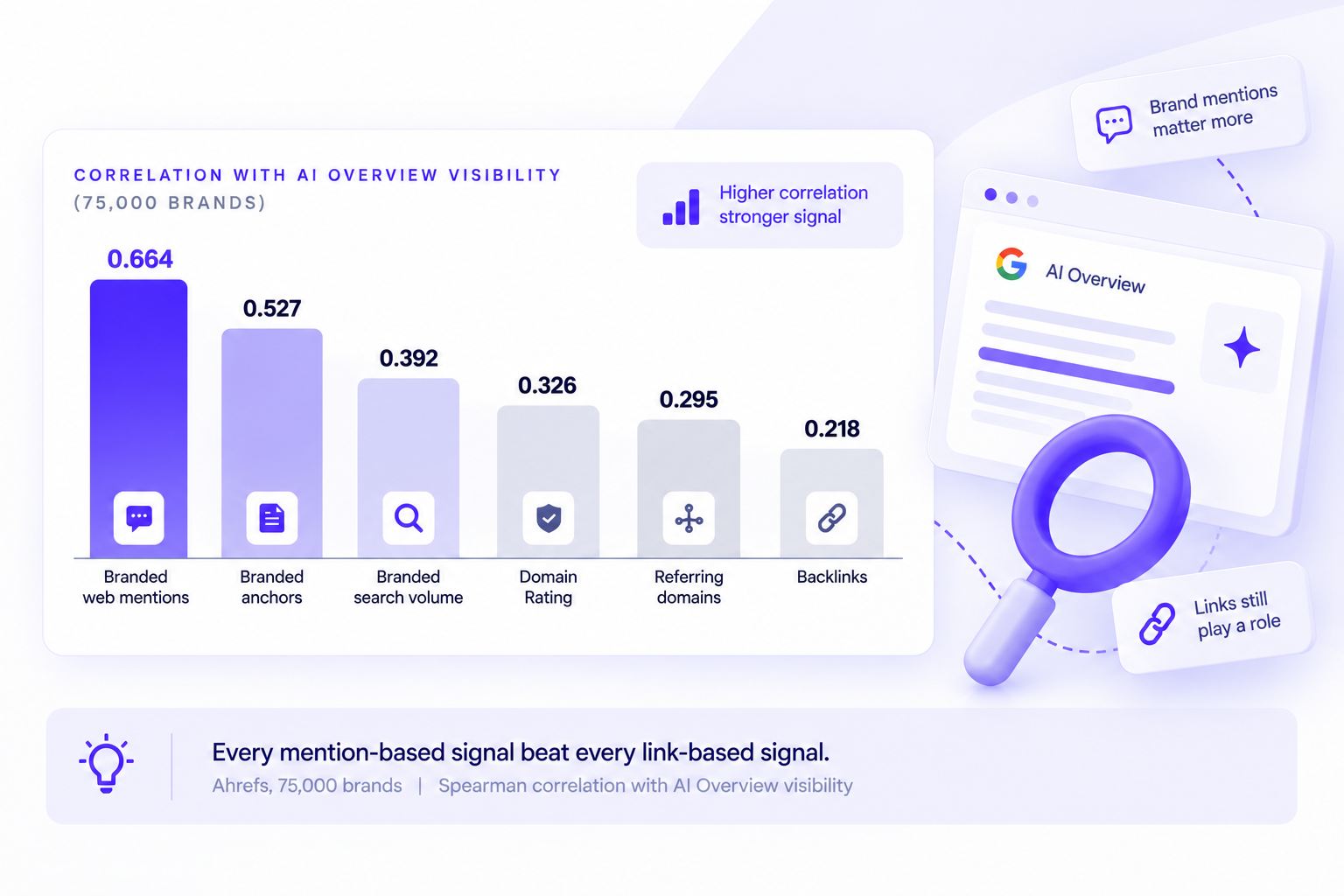
Yes, backlinks still matter for AI search, but they are no longer the strongest signal pulling your brand into an answer. In Ahrefs' study of 75,000 brands, backlinks correlated just 0.218 with AI Overview visibility, while unlinked brand mentions correlated 0.664 (Louise Linehan and Xibeijia Guan, Ahrefs, 26 May 2025).
That single gap explains most of the confusion in our client calls this year. A brand can hold a strong backlink profile and still be invisible inside ChatGPT, Perplexity, and Google AI Overviews. So the honest answer is that backlinks have not stopped working. They have changed jobs, and the agencies still selling link count as the whole strategy are measuring the wrong thing.
Backlinks are a moderate signal for AI visibility, not a top one. Ahrefs measured six factors against AI Overview presence across 75,000 brands and ranked them by Spearman correlation: branded web mentions (0.664), branded anchors (0.527), branded search volume (0.392), Domain Rating (0.326), referring domains (0.295), and raw backlinks (0.218).
Read that order carefully. Every mention-based signal beat every link-based signal. Referring domains, which most agencies still sell as the headline metric, landed near the bottom. This does not mean links are worthless. It means the thing links used to prove, that other people find you credible, is now measured more directly through how often people write your name.
There is a caveat worth stating up front. That study measured Google AI Overviews, not ChatGPT or Perplexity, and correlation is not causation. It shows a strong relationship, not proof that a link never helps. But the direction matches what other datasets show, which is why we trust the pattern rather than the single number.
For a fuller picture of how link signals differ from each other, our guide on referring domains vs backlinks breaks down why domain count outperforms raw link volume.
AI engines read language, not just link graphs. Classic Google ranking leaned heavily on PageRank, where a link was a vote. Large language models are trained on text, and they retrieve from live indexes at answer time. When an engine decides which brands to name for "best link building agency," it is pattern-matching across how those brands appear in sentences, reviews, and roundups, not counting votes.
Links still feed that process, but in a supporting role. They help engines discover and crawl your content, and they help your pages earn placement on the third-party sites that AI actually quotes. The link itself is a delivery mechanism now, not the payload. The payload is the mention that travels with it.
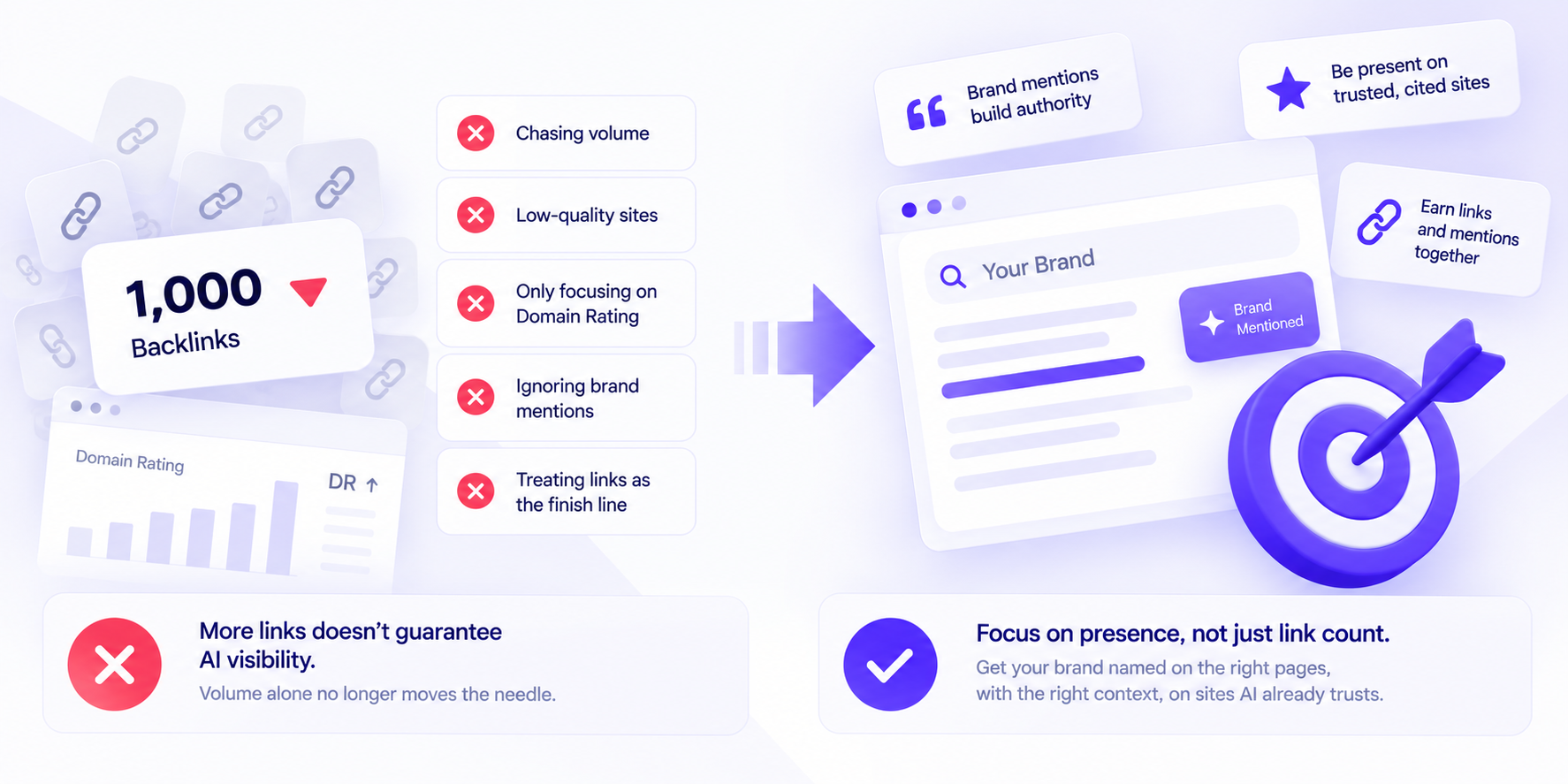
There is a second reason links lost primacy. Link spam got industrialised, and both Google and the AI engines learned to discount it. A thousand low-quality links now signal almost nothing, while ten genuine mentions on trusted, frequently cited sites move the needle. Quality was always the point, and understanding how backlinks work as a trust layer rather than a numbers game is what separates campaigns that survive from campaigns that get filtered out.
Backlinks still matter for indexation, for reaching third-party citation sources, and for baseline trust. Around 84% of AI citations point to third-party pages rather than a brand's own site (Muck Rack, May 2026, 25 million links analysed). You do not control most of those pages directly. You reach them through the same outreach muscle that link building has always used: guest placements, digital PR, and earned coverage that carries both a link and a named mention.
The kind of site matters more than ever. AI engines cite some sources far more than others. A study of 30 million sources found Reddit, YouTube, LinkedIn, Wikipedia, and Forbes are the most-cited domains across the major engines (Peec AI, 31 March 2026). A link or mention on one of those platforms is worth more for AI visibility than a dozen links on sites no engine ever quotes. This is why link placement strategy now starts with the question of whether AI engines already read the target site.
This is the part agencies miss. The skill that wins backlinks is the same skill that wins brand mentions, because both come from getting your brand onto other people's pages. A well-run digital PR strategy produces links and mentions in the same placement, which is why we treat them as one workflow rather than two budgets.
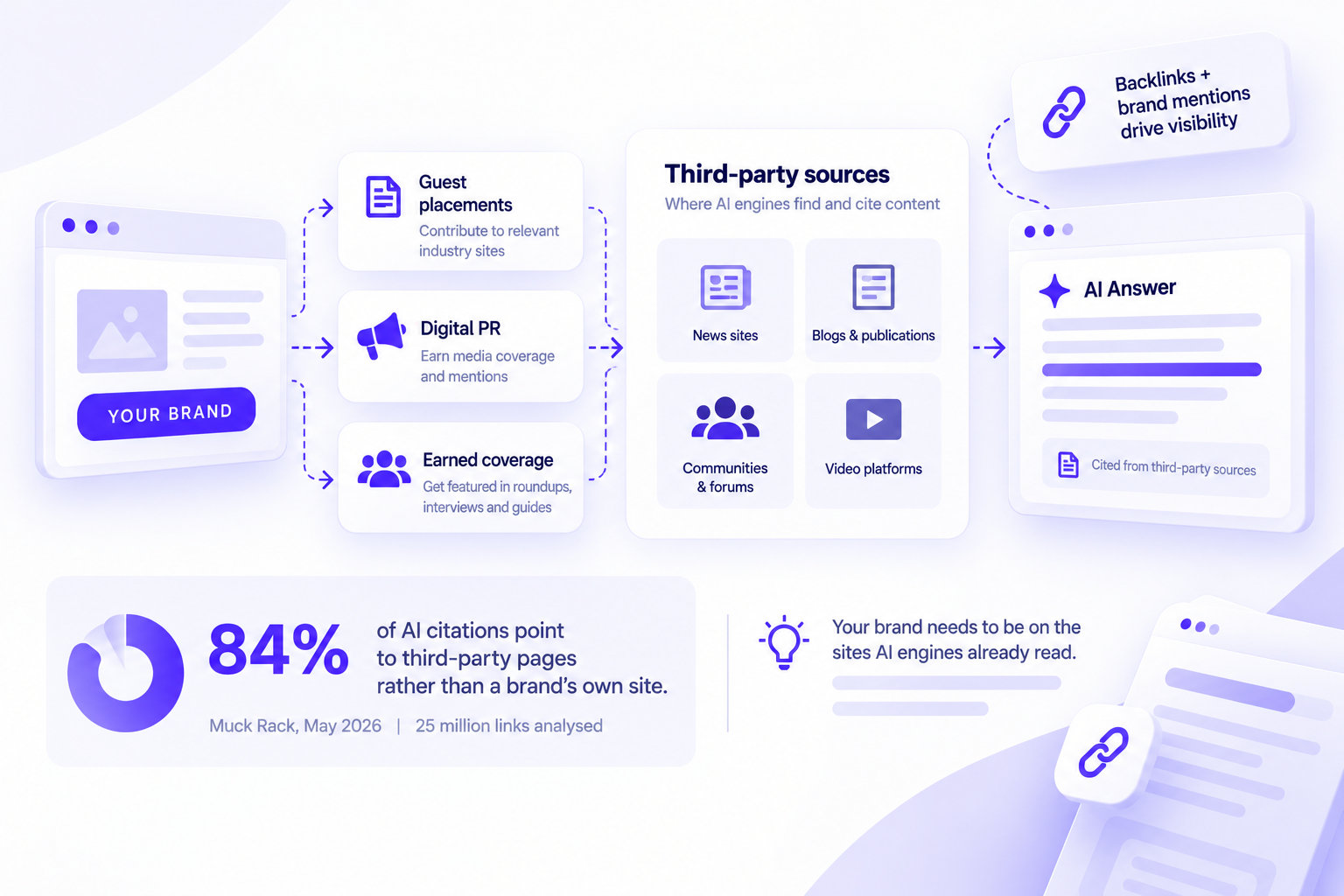
Build links on sites AI engines already cite, and make sure your brand name rides along with every one. In practice that means three moves. First, prioritise placements on high-authority, frequently cited domains over volume on weak sites. Second, ensure the anchor or surrounding text names your brand next to your key claim, not just a keyword. Third, keep the unlinked brand mentions you already have, because those text mentions are the exact signal Ahrefs found correlates highest.
A useful test before pursuing any link is simple. Ask whether an AI engine would ever quote the page you are targeting. If the answer is no, the link may still help classic SEO, but it does little for AI visibility. If the answer is yes, that single placement can do double duty.
Vetting matters here too. A link from a spun-content farm can drag your entity associations in the wrong direction, and our quality backlink vetting checklist covers how to separate placements worth chasing from ones that quietly hurt you.
Stop optimising for a backlink count and start optimising for where and how your brand is named. The old scorecard rewarded volume: more links, higher Domain Rating, better rankings. The new scorecard rewards presence: named on the right pages, associated with the right claims, cited by the engines your buyers actually use. Chasing volume on cheap sites now carries real downside, because it dilutes the entity signals that AI engines read.
Links are still worth building. They are just no longer the finish line. If you treat every placement as a chance to earn a link and a mention on a site AI already trusts, the AI-search shift stops feeling like a threat and starts looking like an extension of good digital PR.
Do backlinks help you get cited by ChatGPT?
Indirectly, yes. Backlinks help your content get discovered and help you earn placements on third-party sites that ChatGPT cites. But the citation itself tracks more closely to how often your brand is named in text than to your raw backlink count, so mentions do the heavier lifting.
Are backlinks dead for SEO in 2026?
No. Backlinks still support classic Google rankings and feed AI discovery. They have dropped from the top-ranked visibility signal to a moderate one, sitting behind branded mentions, anchors, and search volume in correlation studies. Dead is the wrong word. Demoted is accurate.
Should I stop link building and only do brand mentions?
No, because the two come from the same work. Most quality placements deliver a link and a mention together. Splitting them is a false choice. Aim for coverage that names your brand and links to it in one placement on a site AI engines already read.
What matters more, Domain Rating or brand mentions?
Brand mentions. Ahrefs found branded web mentions correlated 0.664 with AI Overview visibility against 0.326 for Domain Rating across 75,000 brands. DR still signals baseline trust, but it is not the lever it once was for getting named in AI answers.
Do nofollow links still count for AI visibility?
They can, because AI engines respond to the mention and context around a link, not only its follow status. An unlinked or nofollow mention on a trusted, frequently cited page can still push your brand into AI answers, which is a shift from how classic PageRank treated nofollow.
Which links are most valuable for AI search?
Links on the domains AI engines cite most, such as Reddit, YouTube, LinkedIn, Wikipedia, and Forbes (Peec AI, 30 million sources, March 2026). A placement on one of these does more for AI visibility than many links on sites no engine quotes, so target placement quality over volume.
Backlinks still matter for AI search, but the scoreboard has changed. The brands winning inside AI answers are the ones being named often, on the sites engines trust, and links are one of the best ways to earn those named placements. At Profit Engine we build links and brand mentions in the same campaign, and we target the domains AI engines already cite, because in 2026 that is what earns both rankings and citations. If your backlink profile is strong but your AI visibility is flat, the gap is almost always mentions on the right sites, and that is a fixable problem.