

Contents
Demo Link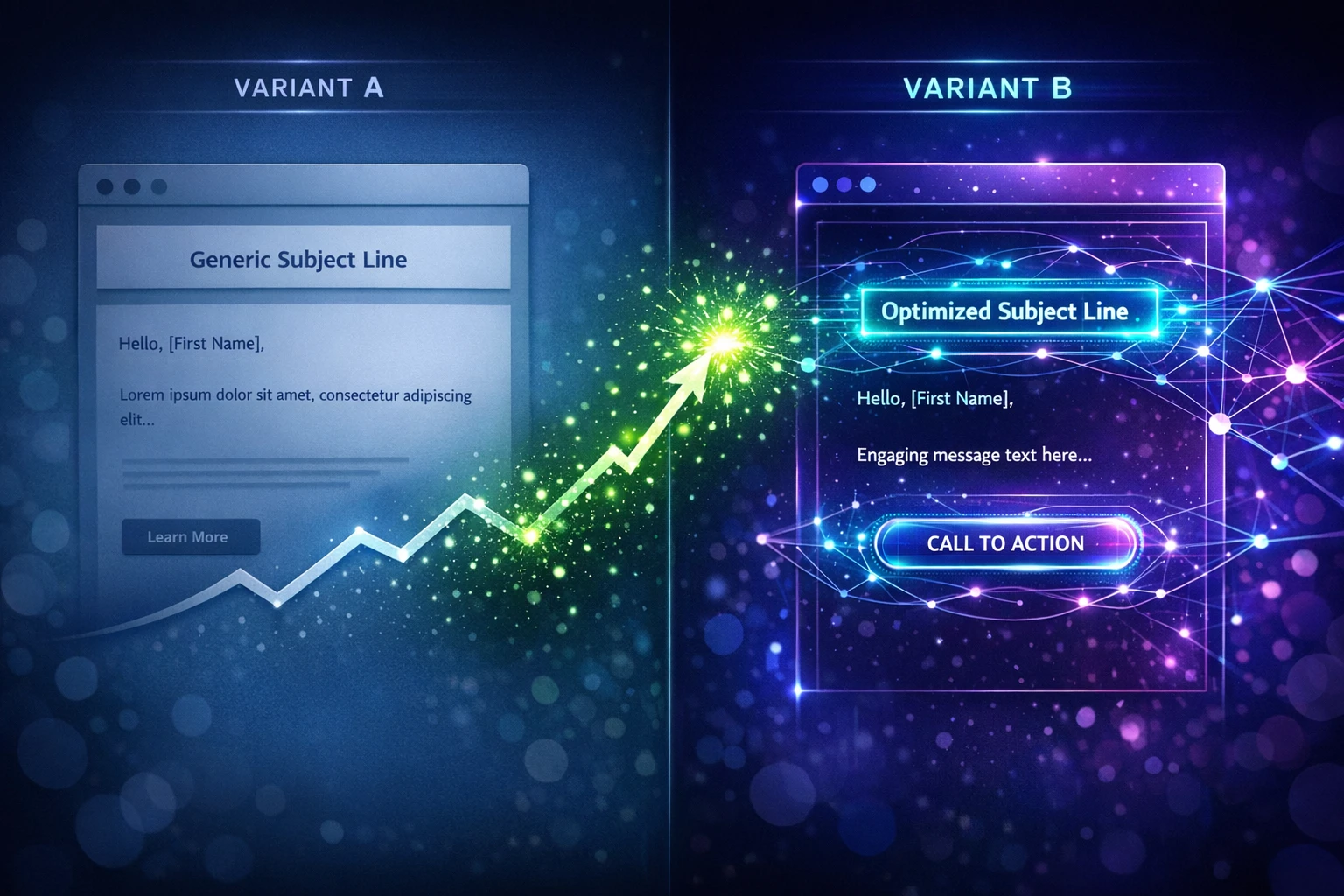
We’ve all been there. You craft what feels like the perfect outreach email. You’ve researched your prospect, personalized the opening line, and polished your request. You hit send, wait for the replies to roll in, and… nothing. You’re left staring at a 12% open rate, wondering what went wrong.
In the high-stakes world of digital marketing in 2026, relying on gut feeling to write outreach templates is a recipe for ignored messages. Even traditional A/B testing—where you manually test one subject line against another and wait a week for results—is no longer fast or efficient enough to keep up.
Today, Artificial Intelligence has transformed from a simple writing assistant into a continuous, dynamic testing engine. AI doesn't just write your emails; it systematically tests, analyzes, and optimizes every element of your outreach, from the first word of your subject line to the final click of your Call-to-Action (CTA).
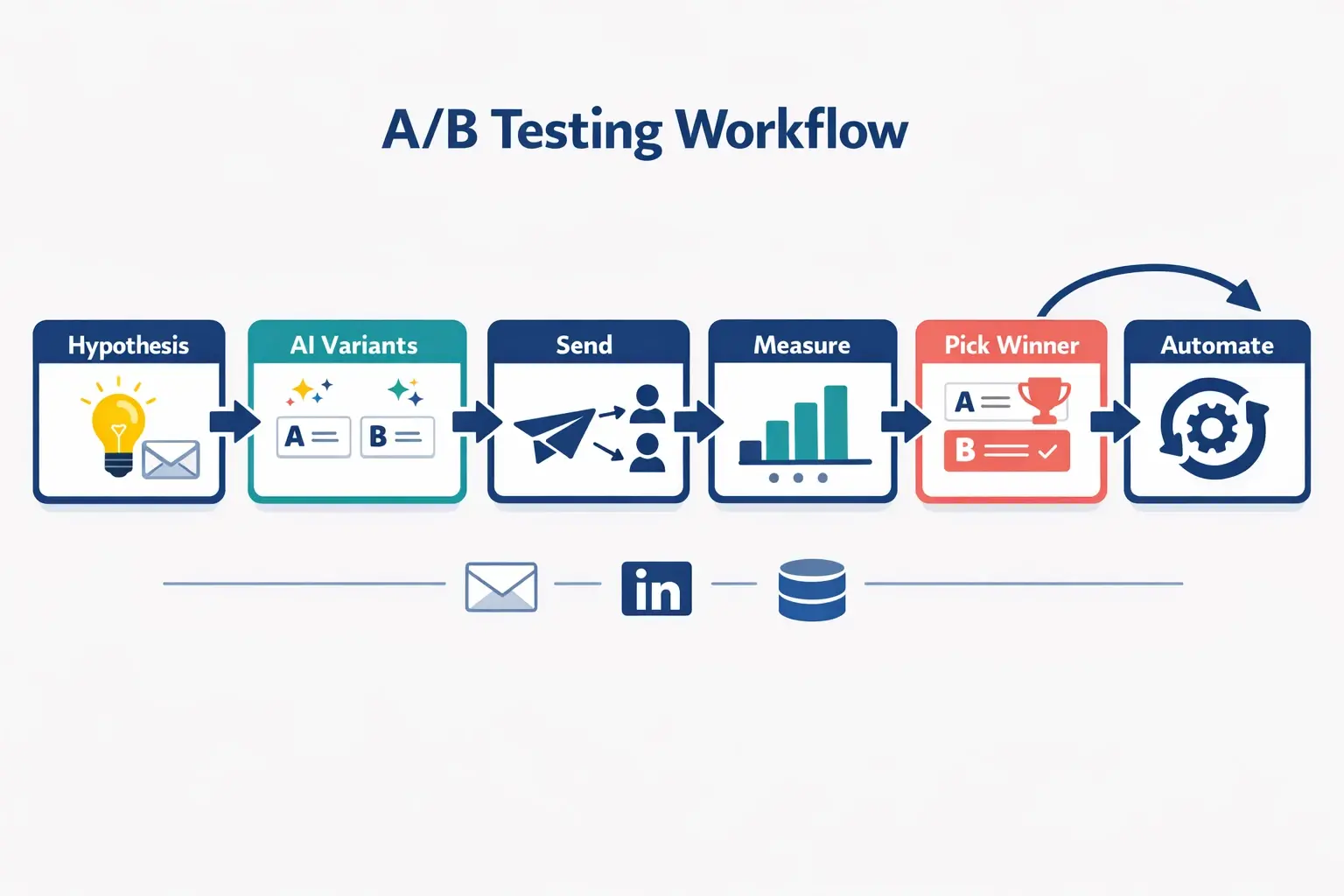
AI email A/B testing uses artificial intelligence to generate, evaluate, and optimise email variations based on real performance data. Instead of manually testing one subject line or CTA at a time, AI can identify patterns, predict performance, and accelerate experimentation across multiple email elements. For outreach campaigns, this helps marketers improve open rates, click-through rates, and response rates with less manual effort.
To understand the AI revolution, we first need to look at traditional A/B testing. At its core, A/B testing involves sending Variant A to one segment of your audience and Variant B to another to see which performs better.
The golden rule of traditional testing was always "test one variable at a time." If you change the subject line and the CTA simultaneously, you won't know which change caused the spike in conversions. While scientifically sound, this manual process is painfully slow. By the time you find statistical significance, your audience's behavior or industry trends may have already shifted.
AI changes the game by combining Generative AI (which creates the content) with Predictive AI and Machine Learning (which analyzes data and predicts outcomes).
Whether you are managing standard PR pitches or executing highly targeted link building outreach, AI algorithms allow you to:
The difference between a deleted email and a booked meeting usually comes down to two elements: the subject line (which earns the open) and the CTA (which earns the click).
Human marketers often fall back on tired formulas ("Quick question," "Partnership opportunity"). AI, on the other hand, can analyze thousands of successful campaigns across your industry to spot invisible patterns.
AI doesn't just guess; it uses data to generate variations based on specific psychological triggers:
Once the email is open, the first sentence must hook the reader. If you're running a specialized campaign, like broken link building, AI can test different ways to point out the error on their site—comparing a helpful, collaborative tone against a more direct, value-first approach.
The Call-to-Action is where conversions happen. AI excels at testing the subtle psychology of your ask. It can test "Soft Asks" ("Are you open to learning more?") against "Hard Asks" ("Book a 15-minute call here"). It can also optimize the visual and contextual elements, refining the exact anchor text used in your links to ensure maximum click-through rates.

Ready to put this into practice? Here is a practical framework for implementing AI-driven A/B testing in your outreach:
Once you've mastered basic AI A/B testing, the technology unlocks highly advanced strategies that were previously impossible for small teams to execute.
While A/B testing compares two distinct versions of an email, multivariate testing tests multiple variables simultaneously (e.g., 3 different subject lines, 2 different opening hooks, and 3 different CTAs).
Historically, this required a massive sample size. Today, AI can rapidly identify the specific combination of elements that yields the highest conversion rate, isolating the impact of each variable without needing millions of recipients.
This is perhaps the biggest "aha moment" in modern AI testing. In traditional A/B testing, you split traffic 50/50, wait for a winner, and then send the winner to the rest of the list. This means 50% of your initial test group received the "losing" variation.
AI introduces the Multi-Armed Bandit approach. Imagine a casino where an AI is pulling different slot machine levers (bandits). As soon as the AI notices one lever is paying out slightly more, it dynamically shifts more of its tokens to that lever while still testing the others. In outreach, this means your campaign optimizes in real-time. If Subject Line B shows an early lead, the AI automatically sends it to 70% of your audience, minimizing lost opportunities.

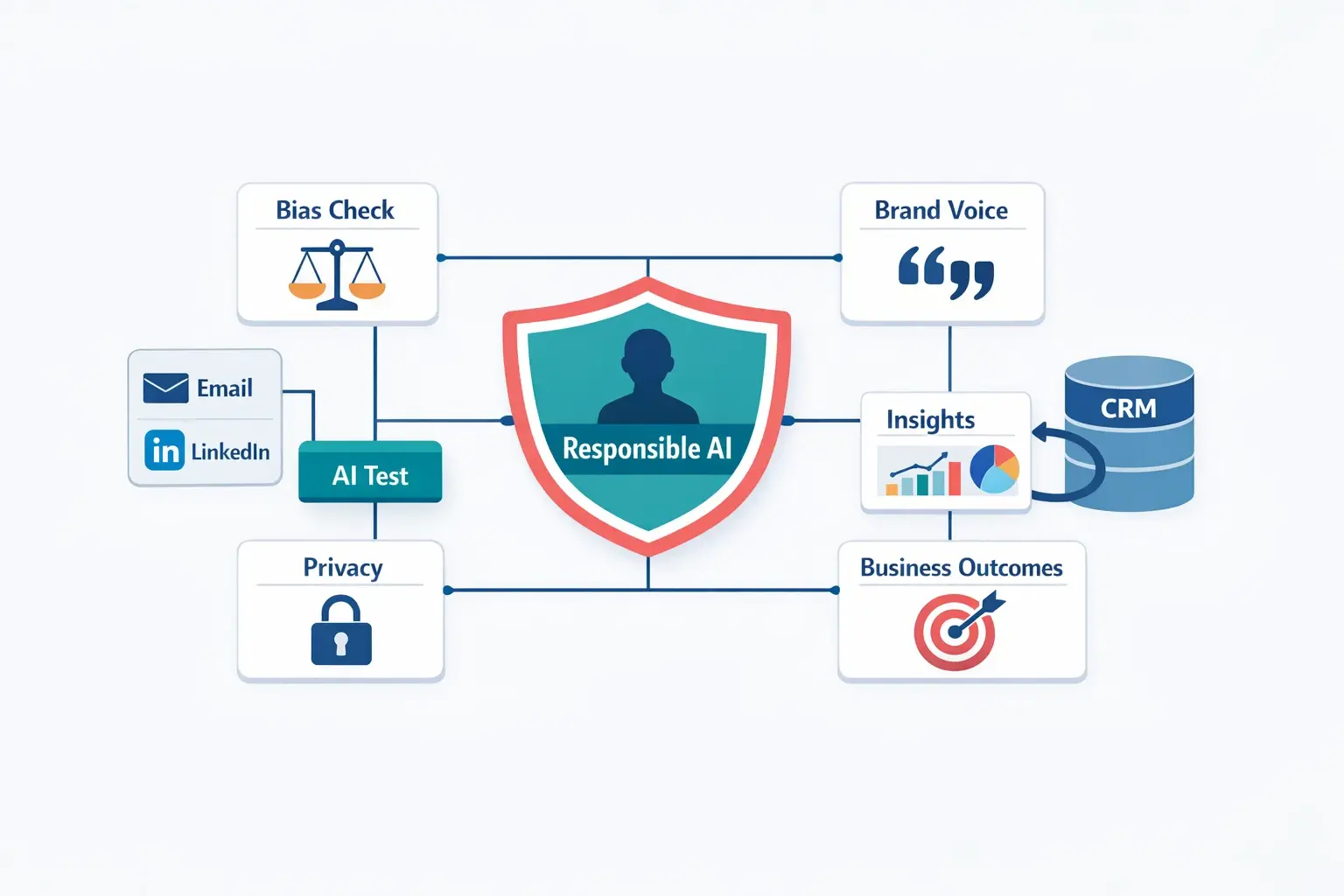
It's easy to look at these capabilities and think you can put your outreach on autopilot. However, a common misconception is that AI operates flawlessly without human intervention.
AI lacks emotional intelligence and brand context. If left unchecked, an algorithm optimizing purely for "open rates" might generate clickbait subject lines that severely damage your brand reputation and result in spam complaints.
Human oversight is your essential guardrail. You must review the variants AI generates before they go live. Establish clear brand voice guidelines within your prompts to ensure the AI doesn't stray into aggressive or off-brand territory.
To truly harness this power, your AI testing shouldn't live in a silo. It needs to connect seamlessly with your CRM and broader marketing ecosystem.
For instance, optimizing outreach isn't just about opens; it's about down-funnel metrics like booked meetings or acquired links. By integrating your AI testing platform with your CRM, the algorithm learns which templates generate the highest quality leads, not just the most clicks.
This level of integration is incredibly valuable for scaling operations. For example, link building for seo agencies often requires managing hundreds of client campaigns simultaneously. Utilizing an automated link building service that incorporates AI A/B testing allows agencies to continuously optimize outreach performance across multiple niches without proportionally increasing headcount. Furthermore, the modern market offers a variety of automated link building tools that have these AI testing capabilities natively built-in, creating a seamless feedback loop from prospect discovery to campaign optimization.
What is the minimum sample size I need for AI A/B testing?While traditional A/B testing often requires thousands of recipients to achieve statistical significance, AI algorithms (especially those using multi-armed bandits) can detect patterns and optimize with smaller datasets, often adjusting strategies after just a few hundred sends. However, the larger your list, the more accurate the AI's predictions will be.
Can AI write my entire outreach email?Yes, but we don't recommend it as a final product. AI is best used as a sophisticated drafting and optimization tool. You should let AI generate the structure, test the subject lines, and formulate the CTAs, but a human should always review the final copy for empathy, brand voice, and genuine personalization.
What happens if an AI test results in a lower open rate?This is actually a successful test! Finding out what doesn't work is just as valuable as finding out what does. AI learns from these "failures" to ensure future variations avoid those specific phrasings or tactics, leading to smarter long-term optimization.
Is AI A/B testing only for email?Not at all. These same principles apply to LinkedIn direct messages, SMS marketing, and even the headlines on your landing pages. The core methodology—generating variants, measuring engagement, and continuous optimization—is channel-agnostic.
If you're still relying on static templates and manual guesswork, you're leaving conversions on the table. The shift from manual A/B testing to AI-driven continuous optimization is no longer just a futuristic concept—it's the baseline expectation for successful digital marketing in 2026.
To get started, don't try to boil the ocean. Pick your lowest-performing outreach sequence today. Use a generative AI tool to create four distinct subject line variations, and test them in your next send. Monitor the data, lean into the winner, and experience the "aha moment" of data-driven optimization for yourself. As you grow more comfortable with the technology, you can expand into multivariate testing and full-stack integrations, turning your outreach from a guessing game into a predictable, high-converting growth engine.




.webp)


