Contents
Demo Link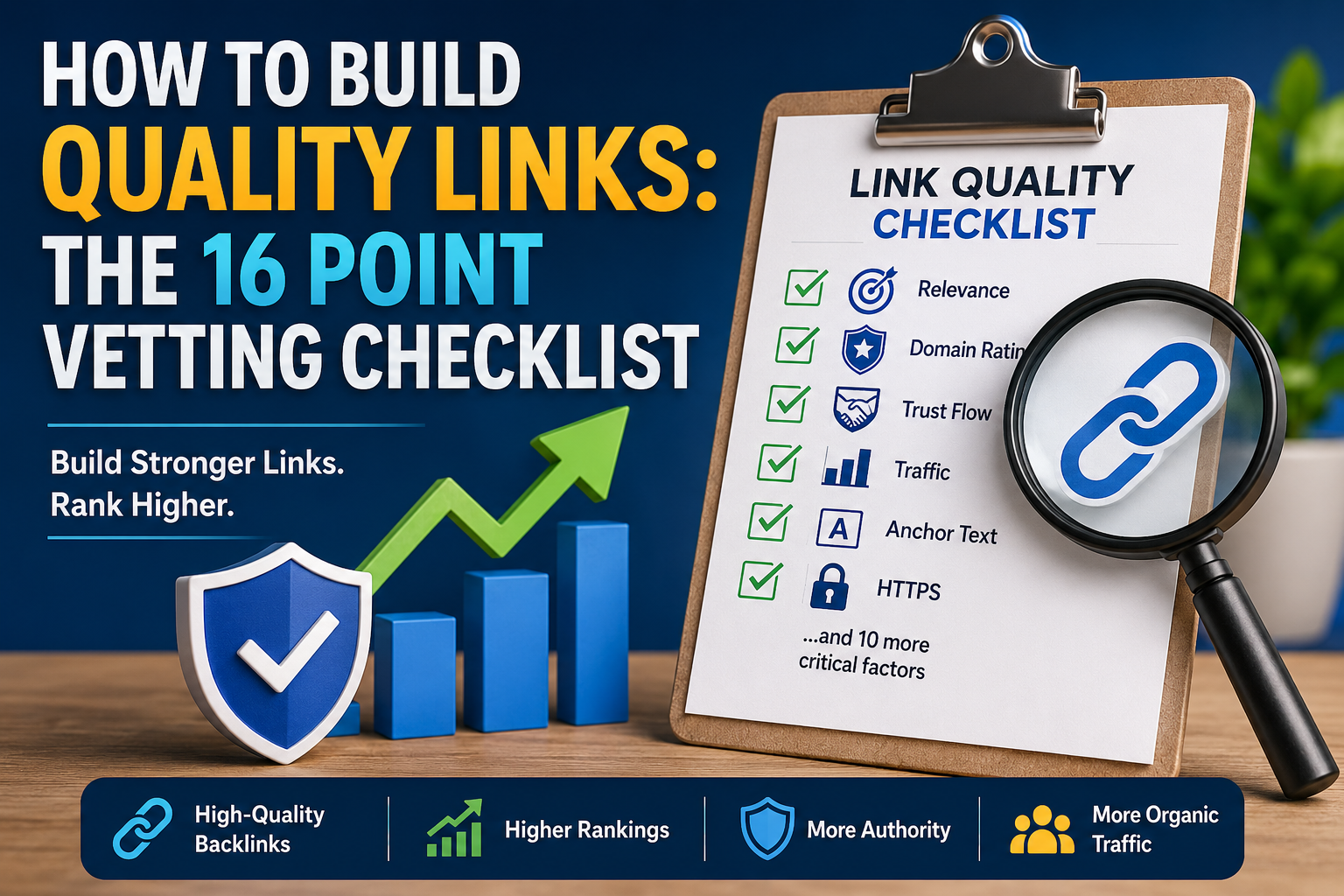
Building backlinks is still one of the strongest ranking factors in SEO. That has not changed.
What has changed is Google’s ability to identify manipulative link building.
Years ago, websites could rank simply by building large volumes of backlinks. Today, poor quality links can hurt rankings just as easily as strong links can improve them. Google’s algorithms now evaluate the relevance, trustworthiness, authority, and overall quality of every link pointing to your website.
This means link building is no longer just a numbers game.
A single backlink from a trusted, relevant website can outperform hundreds of low quality links from spammy domains.
The challenge for most businesses is knowing how to separate good opportunities from bad ones.
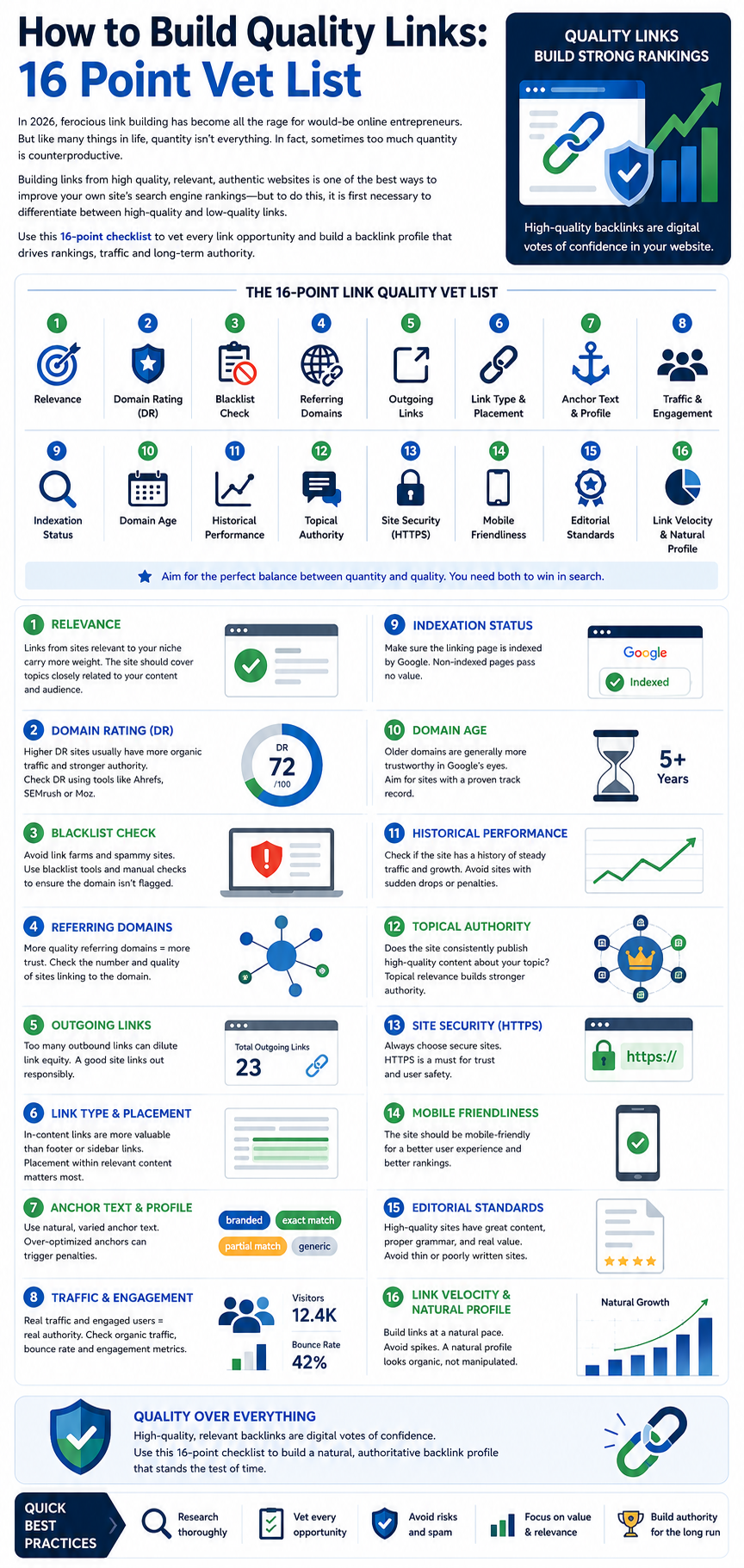
This guide breaks down the 16 most important factors professional SEOs use to evaluate backlinks before building them. These are the same metrics used to determine whether a website is trustworthy, relevant, authoritative, and capable of passing real SEO value.
If you want backlinks that improve rankings instead of putting your website at risk, this checklist matters.
Backlinks act as trust signals.
When a reputable website links to your content, Google interprets that link as a vote of confidence. The stronger and more relevant the referring website is, the more authority your own website receives.
Low quality backlinks create the opposite effect.
Spam links, irrelevant websites, link farms, and manipulative anchor text patterns can trigger algorithmic distrust. In some cases, websites lose rankings because their backlink profiles appear unnatural.
A strong backlink profile helps:
A weak backlink profile does the opposite.
That is why every backlink opportunity should be vetted carefully before you build it.
Relevance is one of the strongest indicators of backlink quality.
Google wants links to make logical sense. A backlink should connect related topics, industries, and audiences.
For example:
The more closely aligned the linking website is to your niche, the stronger the contextual signal becomes.
Check whether the website:
A relevant website typically has:
Avoid websites that:
Many spam sites attempt to look legitimate by covering every topic imaginable. These sites usually provide very little SEO value.
Search:
"[website name] reviews"
If you find complaints, spam reports, or discussions about paid links, avoid the domain entirely.
Domain Rating measures the strength of a website’s backlink profile.
Tools like Ahrefs use DR to estimate how authoritative a website appears based on the quality and quantity of links pointing to it.
In general:
There is no universal number because context matters.
A DR 30 local industry site may be more valuable than a DR 80 general directory.
As a rough guide:
Many businesses chase DR alone.
This leads to irrelevant backlinks from websites that have authority but no topical relevance. Google increasingly values topical alignment alongside authority.
The ideal backlink combines:
Not every website that offers backlinks is safe.
Some websites exist solely to manipulate rankings through paid linking schemes. These are commonly called:
Google actively devalues these sites.
In more serious cases, websites associated with spam networks can receive manual penalties.
Watch for:
Spam outreach emails often include:
If the offer sounds too good to be true, it usually is.
Professional SEO teams maintain internal blacklists of domains they refuse to use.
You should do the same.
Over time, you can identify risky domains by reviewing:
A referring domain is a website that links to your website.
Google evaluates not just the number of backlinks you have, but also how many unique websites link to you.
This is important because:
Diversity matters.
Strong referring domains usually have:
A natural backlink profile grows gradually across many domains.
Too many links from the same source can appear manipulative.
Google wants to see:
Outgoing links are links a website places to external websites.
Every outbound link passes some level of authority.
Websites that link excessively to unrelated domains often dilute their credibility.
Review:
High quality websites link naturally.
Spam sites often overload content with commercial anchor text and unrelated outbound links.
A contextual link inside useful content carries far more value than:
Google understands placement and context.
One of the easiest ways to identify spam websites is by reviewing their inbound and outbound link balance.
If a website constantly links outward but receives very few links itself, it may exist purely to sell backlinks.
Trusted websites usually:
As a general rule:
This is not a perfect metric, but it is a useful warning sign.
Citation Flow measures the quantity of backlinks pointing to a website.
It was developed by Majestic SEO and scores websites on a scale from 0 to 100.
Higher Citation Flow often means:
However, Citation Flow alone does not measure quality.
A spam website can artificially inflate Citation Flow using large volumes of low quality links.
That is why Citation Flow should always be evaluated alongside Trust Flow.
Trust Flow measures backlink quality.
Rather than counting links, it evaluates how closely a website is connected to trusted seed websites online.
Websites with strong Trust Flow typically:
A website with:
…often indicates manipulative link building.
Meanwhile:
…usually indicates stronger website quality.
Trust Ratio compares:
Trust Flow ÷ Citation Flow
This helps determine whether a backlink profile is natural or artificially inflated.
Good websites generally have:
Poor ratios may indicate:
Professional SEOs often use Trust Ratio as a quick filtering mechanism before reviewing a website manually.
Embed Trust Ratio Graphic Here
Suggested Alt Text:
Trust Flow and Citation Flow ratio infographic explaining backlink trust
Traffic is one of the clearest indicators of website legitimacy.
If a website ranks well organically, it usually means Google trusts it to some degree.
Healthy traffic often reflects:
Avoid websites with:
These patterns can indicate penalties or manipulative SEO practices.
Traffic trends matter just as much as current traffic levels.
A website with declining traffic may have:
Good websites usually show:
Be cautious if traffic graphs show:
Traffic stability is often a better signal than temporary spikes.
Traffic geography matters more than many businesses realize.
If your business serves:
…your backlinks should ideally come from websites with audiences in those regions.
Localized backlink relevance can strengthen:
A backlink from a relevant local audience often provides more SEO value than irrelevant international traffic.
Anchor text is the clickable text used in hyperlinks.
Google uses anchor text to understand:
Healthy backlink profiles contain:
Examples:
Over-optimized anchor text patterns can trigger algorithmic distrust.
Avoid:
Natural anchor diversity matters.
HTTPS is a confirmed Google ranking signal.
Secure websites protect users through encrypted connections.
SSL certificates help:
Google prefers secure websites.
Avoid building backlinks from unsecured domains whenever possible.
Look for:
If a page is not indexed by Google, the backlink may provide little or no SEO value.
Indexation confirms that:
Search:
site:domain.com/page-url
If the page does not appear, it may not be indexed.
Pages may fail to index because of:
Indexed links are always preferable.
Do-follow links pass authority signals to the linked website.
These are the links that influence rankings most directly.
Strong do-follow backlinks help:
No-follow links generally pass little direct ranking value.
However, high authority no-follow links can still provide:
Examples include links from:
A natural backlink profile includes both:
The key is maintaining a natural appearance.
Effective link building is no longer about building the largest number of backlinks possible.
Modern SEO rewards:
Every backlink should strengthen your website’s credibility, not weaken it.
By using this 16-point checklist, you can identify high quality opportunities while avoiding the types of links that lead to ranking instability and long-term SEO problems.
Strong backlink profiles are built carefully over time.
The websites that win in search are usually the ones that prioritize quality consistently.
A high quality backlink comes from a trustworthy, authoritative website that is relevant to your industry or topic. The best backlinks are editorially placed, appear naturally within content, and come from websites with real organic traffic and strong reputations.
Google values backlinks that demonstrate genuine trust and relevance rather than artificial link manipulation.
Backlinks help search engines understand which websites are trustworthy and authoritative.
When reputable websites link to your content, Google treats those links as signals of credibility. Strong backlinks can improve:
Backlinks remain one of Google’s strongest ranking factors in 2026.
Yes.
Low quality backlinks from spam websites, link farms, or irrelevant domains can negatively impact your rankings. Google’s algorithms are designed to identify manipulative link building practices.
Toxic backlinks may lead to:
That is why backlink quality matters far more than backlink quantity.
A backlink is considered relevant when it comes from a website that covers topics closely related to your industry, niche, products, or services.
For example:
Topical relevance helps search engines better understand your website’s authority within a subject area.
You can evaluate backlink quality using several SEO metrics, including:
SEO tools like Ahrefs, SEMrush, Moz, and Majestic can help analyze these metrics.
Domain Rating is a metric developed by Ahrefs that estimates the authority of a website based on its backlink profile.
Higher DR websites generally have:
However, DR should always be evaluated alongside relevance and traffic quality.
Citation Flow measures the quantity of backlinks pointing to a website.
Trust Flow measures the quality and trustworthiness of those backlinks.
A healthy backlink profile usually has balanced Citation Flow and Trust Flow metrics. High Citation Flow with very low Trust Flow can indicate spammy link building.
No.
While no-follow links generally pass less direct SEO authority than do-follow links, they can still provide:
High authority no-follow links from major publications can still benefit your website.
There is no exact number.
The number of backlinks required depends on:
In most cases, a smaller number of high quality backlinks will outperform large volumes of low quality links.
Toxic backlinks are links from spammy, manipulative, or low trust websites that may harm your SEO performance.
Examples include:
These links can create unnatural backlink patterns that reduce trust signals.
Common signs of a link farm include:
If a website appears to exist solely for selling backlinks, avoid it.
No.
A natural backlink profile usually contains a mix of:
Google expects backlink profiles to appear natural. An unnatural concentration of only do-follow links can look manipulative.
Anchor text is the clickable text within a hyperlink.
Google uses anchor text to understand the topic and relevance of linked pages.
Healthy anchor text profiles typically include:
Over-optimized anchor text can trigger spam signals.
Yes.
Organic traffic is one of the clearest indicators of website quality. Websites with real traffic are more likely to:
Backlinks from websites with no traffic often provide very little value.
HTTPS indicates that a website uses an SSL certificate to secure data and protect users.
Google considers HTTPS a trust and ranking signal. Secure websites are generally safer and more trustworthy backlink sources.
SEO results vary depending on competition and authority levels.
In many cases, backlinks begin influencing rankings within:
Strong SEO results usually come from consistent, long-term link building rather than short-term spikes.
The safest link building strategies focus on:
Examples include:
Avoid manipulative tactics designed purely to game search rankings.
Absolutely.
Despite advances in AI and semantic search, backlinks remain one of Google’s strongest trust and authority signals.
Search engines continue to rely on backlinks to evaluate:
Strong backlinks continue to play a major role in competitive SEO rankings.
Profit Engine helps businesses build authoritative backlink profiles through:
We focus on relevance, authority, and long-term ranking stability rather than spam tactics that create short-term results.
If you want backlinks that improve rankings without putting your website at risk, our team can help.