

Contents
Demo Link
Imagine this: You’ve just crafted a highly personalized pitch to a top-tier industry editor for a high-value backlink. You hit send. Three days pass. Crickets.
Now comes the universal dilemma of every SEO and digital PR professional. Do you follow up right now? Should you wait until next Tuesday? Do you send a gentle "just bubbling this up" bump, or do you completely rewrite the pitch with a different angle?
If you guess wrong, you risk annoying a valuable prospect or losing your email to the abyss of a Monday morning inbox purge. For years, the industry relied on generic rules of thumb—"always follow up on Thursday at 10 AM." But in 2026, relying on gut feelings and outdated playbooks is a fast track to the spam folder.
Enter Predictive AI.
By analyzing massive datasets of engagement history, behavioral signals, and inbox activity patterns, modern AI doesn't just guess when to send an email. It calculates the exact moment your recipient is most likely to be receptive, and dynamically adjusts the message to match their intent. Let's lift the hood on how this technology is transforming link building outreach from a volume game into a precision science.
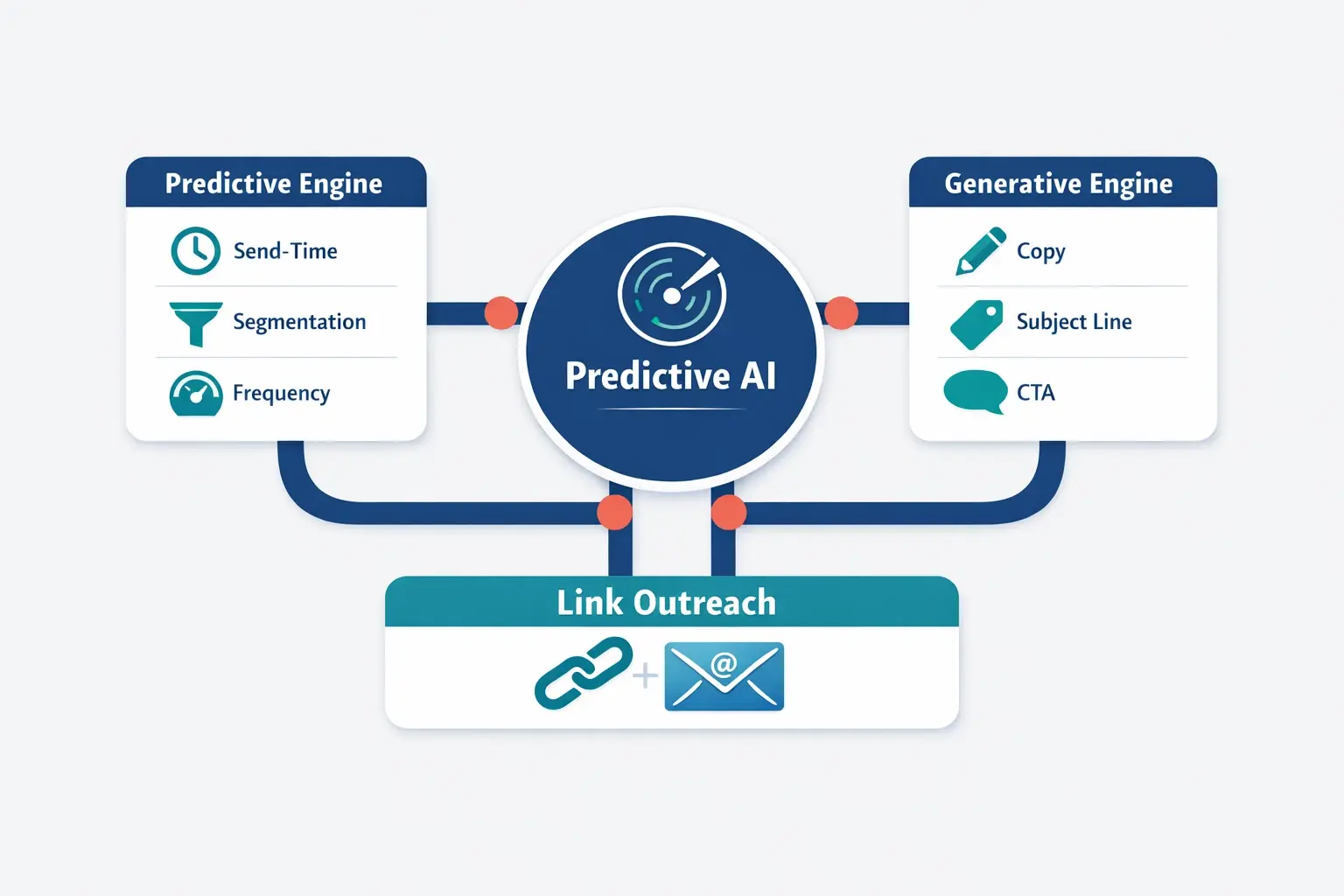 This map shows how predictive AI (timing, segmentation, frequency) pairs with generative AI (copy variations) to create follow-ups that feel timely and relevant for link outreach.
To understand where we are today, we must first clear up a common misconception. When most people hear "AI in email," they immediately think of Generative AI—tools like ChatGPT writing the actual email copy.
While generating copy is useful, it’s only half the equation. The real breakthrough in 2026 is the Dual-Engine Model, which marries Generative AI with Predictive AI.
In the context of acquiring high-quality backlinks, this means your outreach doesn't just sound natural; it arrives exactly when the webmaster or journalist is sitting at their desk, sipping their coffee, ready to review pitches.
You might be wondering: How does a machine actually know when Editor Sarah wants to read my email?
It’s easy to get bogged down in technical jargon like "gradient boosting" or "neural networks," but at its core, predictive AI operates like a highly sophisticated decision tree. It continuously ingests engagement data and looks for hidden patterns humans simply can't spot at scale.
Here are the primary signals the AI analyzes to determine optimal follow-up timing and content:
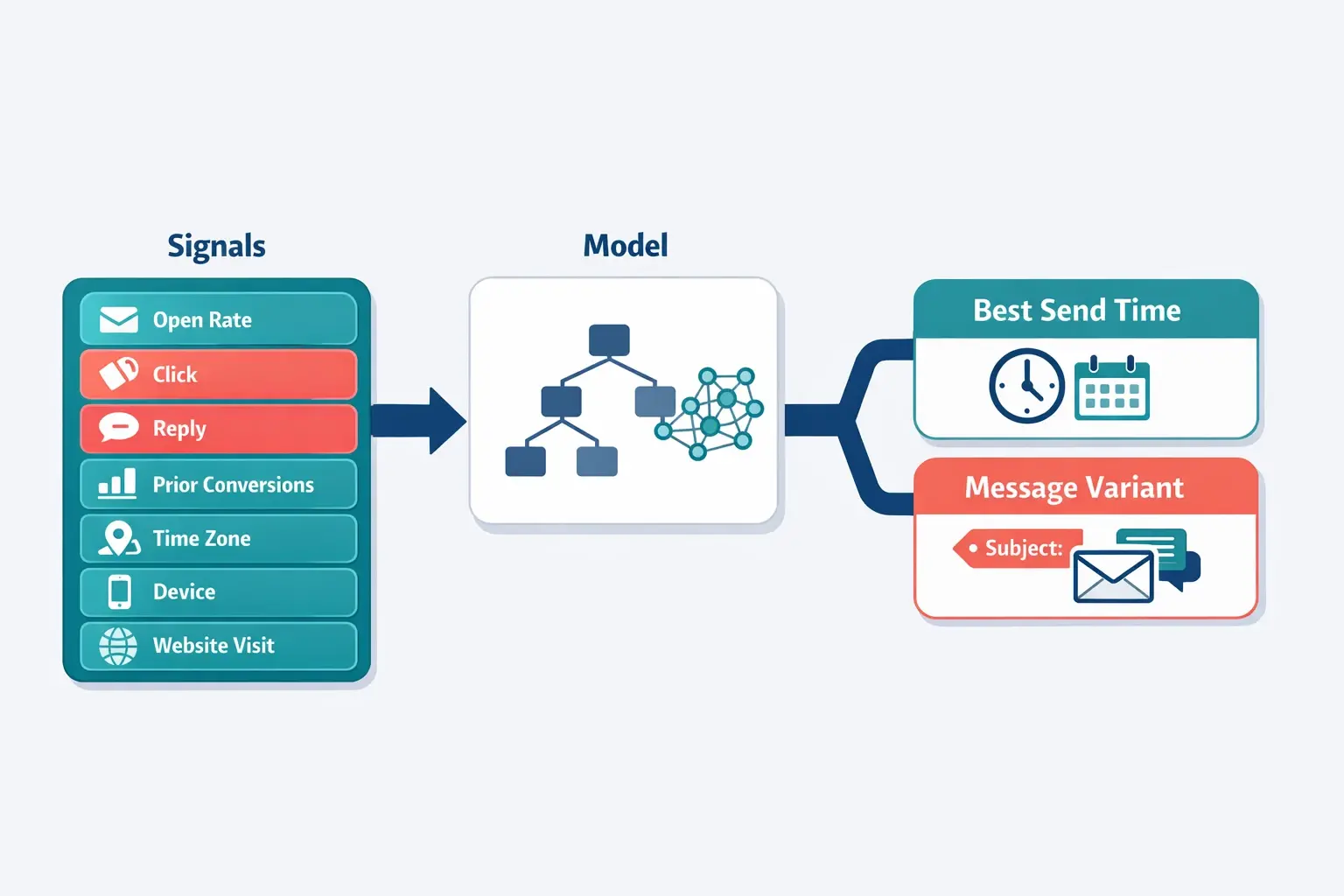 Predictive models turn engagement and behavior signals into two practical recommendations: when to follow up and which copy variation to send—optimized per recipient patterns.
Transitioning to an AI-driven outreach strategy doesn't happen overnight. It requires a foundational shift in how you handle data. Here is the practical rollout path to ensure your AI works for you, rather than confusing your prospects.
Predictive AI is only as intelligent as the data feeding it. If your CRM is filled with outdated contacts and messy histories, the AI will make poor predictions. Before flipping the switch, you must standardize your contact lists. Walking through a rigorous link building checklist to ensure you are targeting the right domains and maintaining clean data records is non-negotiable.
AI shouldn't send the exact same sequence to everyone. You need to define the "rules of engagement." For instance:
A "set it and forget it" mentality is the biggest mistake beginners make. Human review remains essential. You should establish control groups (where emails are sent manually) to test against AI performance. Furthermore, human strategists must review AI-generated follow-up copy to ensure it aligns with your brand voice and doesn't sound robotic. Learning how to manage your backlinks and outreach profiles manually first makes you a much better editor of AI outputs.
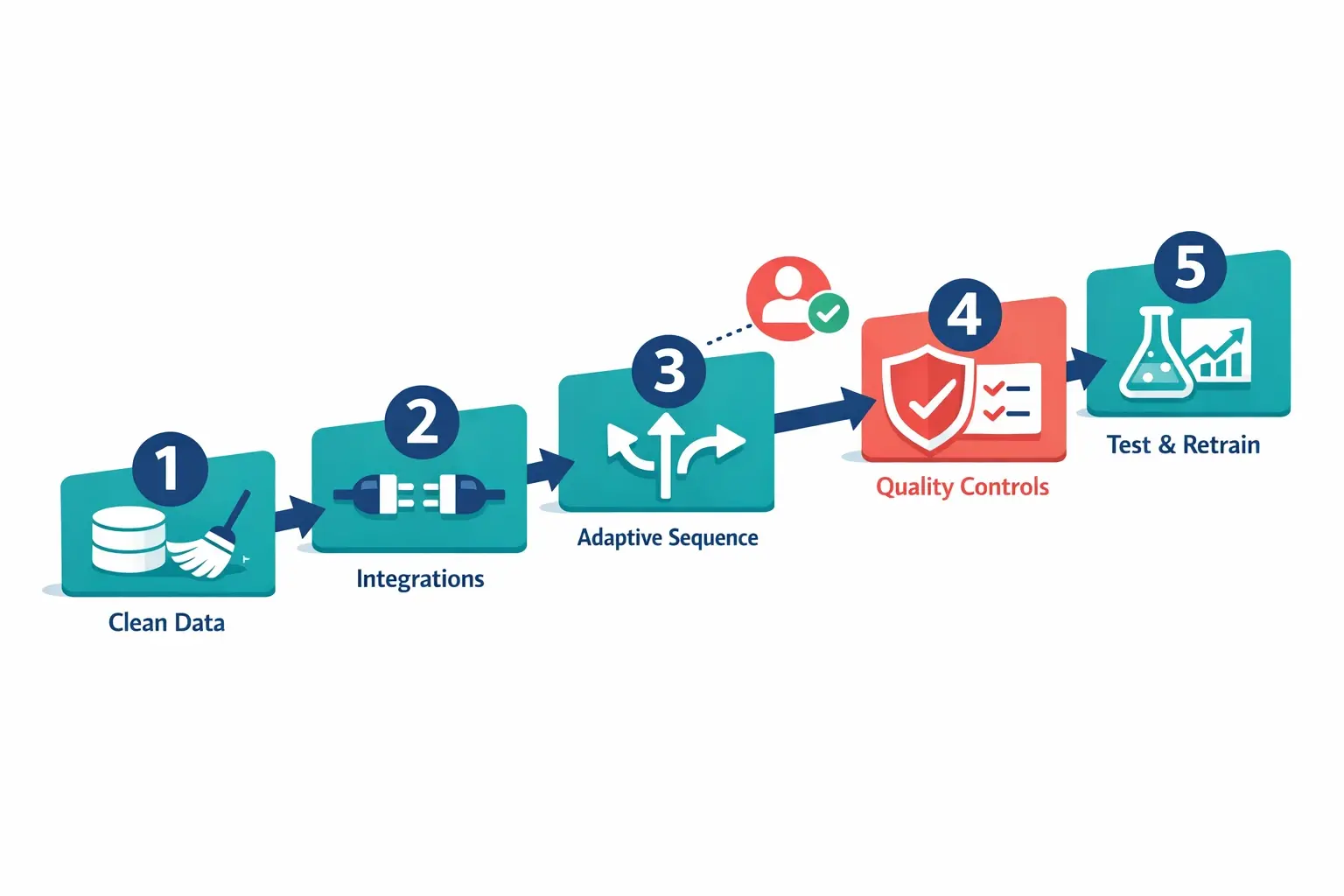 A practical rollout path: start with data hygiene, connect systems, build adaptive follow-ups, add quality gates and human review, then validate impact with controlled tests and retraining.
As with any advanced technology, integrating predictive AI into your link acquisition efforts comes with learning curves.
How does the AI know when to follow up if you've never emailed this person before? This is known as the "cold start" problem. In these cases, the predictive model relies on aggregate data. It looks at similar prospects in similar industries to make an educated initial guess, refining its predictions as the specific prospect begins to interact. This is where partnering with an automated link building service that already possesses vast troves of industry engagement data can provide an immediate advantage.
Just because someone opened an email 10 times doesn't mean they want to link to you; they might just be confused by your pitch! This is where integrating tools to find unlinked mentions ahrefs style data can help. By combining external SEO data (knowing they already mentioned your brand) with internal AI email data, you can accurately gauge true intent.
When executed correctly, predictive AI has been shown to increase open rates by 20-30% and significantly boost response rates. However, with great power comes the responsibility not to abuse the inbox.
High-quality link building is fundamentally about relationship building. Bombarding webmasters with AI-generated emails at all hours crosses the line into spam. If an editor feels stalked by an algorithm that emails them the exact second they open their laptop, trust is broken. Worse, aggressive and uncalibrated outreach can look incredibly suspicious to search engines, bordering on the type of careless behavior associated with dark seo.
To maintain credibility, prioritize frequency optimization. Let the AI tell you when to pull back. If a prospect is highly unresponsive, a smart predictive model will suggest pausing outreach to preserve the domain's reputation. Ultimately, your success shouldn't just be measured by volume, but by examining the actual link metrics and the quality of the relationships you are cultivating.
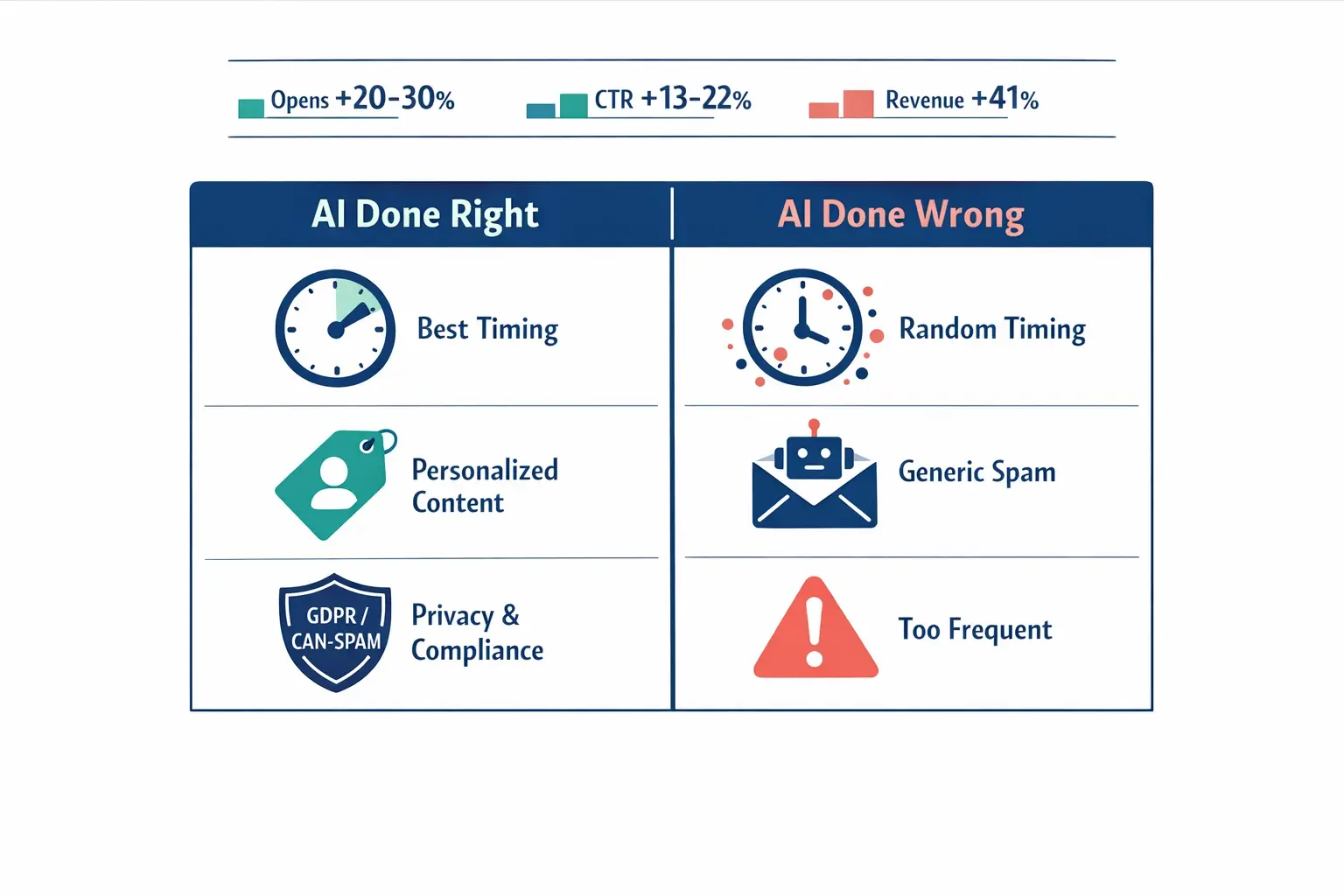 Use predictive AI to improve outcomes without crossing the line: optimize timing and personalization, respect preferences and regulations, and avoid over-frequency that harms relationships.
Does predictive AI guarantee a 100% open rate?No. Human behavior is inherently unpredictable. A prospect might be on vacation, dealing with a site outage, or simply having a busy day. Predictive AI significantly increases the probability of your follow-up being seen, but 100% accuracy is an impossible metric.
Will using AI make my emails sound robotic?Not if you use the Dual-Engine model correctly. Predictive AI simply handles the timing and strategy. When using generative AI for content, human oversight is vital. You must pre-train the AI on your brand guidelines and manually review copy variations to ensure authenticity.
How does predictive AI comply with privacy laws like GDPR or CAN-SPAM?Compliance is critical. Reputable AI platforms aggregate and anonymize data to look for patterns without exposing personally identifiable information (PII). Furthermore, predictive AI can actually help with compliance by automatically identifying and suppressing follow-ups to contacts who have shown negative engagement signals or opted out.
Is this only for enterprise-level agencies?In 2026, predictive AI has been heavily democratized. While large enterprise systems exist, many modern outreach tools and specialized SEO strategies now bake these predictive capabilities directly into their standard workflows, making them highly accessible for small and medium-sized businesses.
The evolution of link outreach has shifted away from simply shouting the loudest to speaking at the exact right moment. By understanding how predictive AI utilizes historical data, behavioral signals, and engagement velocity, you are no longer sending follow-ups into the void.
Start small. Audit your current CRM data, identify the friction points where your manual follow-ups are failing, and consider how a data-driven approach could turn those missed connections into valuable digital partnerships. The future of link building isn't about working harder; it's about letting the data tell you precisely when to reach out.





.webp)

