

Contents
Demo Link
Imagine pouring thousands of dollars and countless hours into growing your website's authority, only to watch your traffic vanish overnight. For years, this was the grim reality for webmasters who unknowingly built their foundation on toxic links. But as we navigate the digital landscape of 2026, the game has fundamentally changed. The era of sneaking low-quality backlinks past search engines is over, replaced by a relentless, highly sophisticated algorithmic gatekeeper.
Today, artificial intelligence doesn't just crawl the web; it actively interprets it. Search engines have deployed advanced machine learning models to identify manipulative link networks—specifically Private Blog Networks (PBNs) and link farms—in real-time. If you're a digital marketer, SEO professional, or business owner, understanding how this algorithmic spam vetting works isn't just an advantage anymore; it's a critical survival skill.
Let's pull back the curtain on how AI "thinks" about link quality, how it detects manipulative patterns, and what you need to know to build a truly resilient, future-proof digital presence.
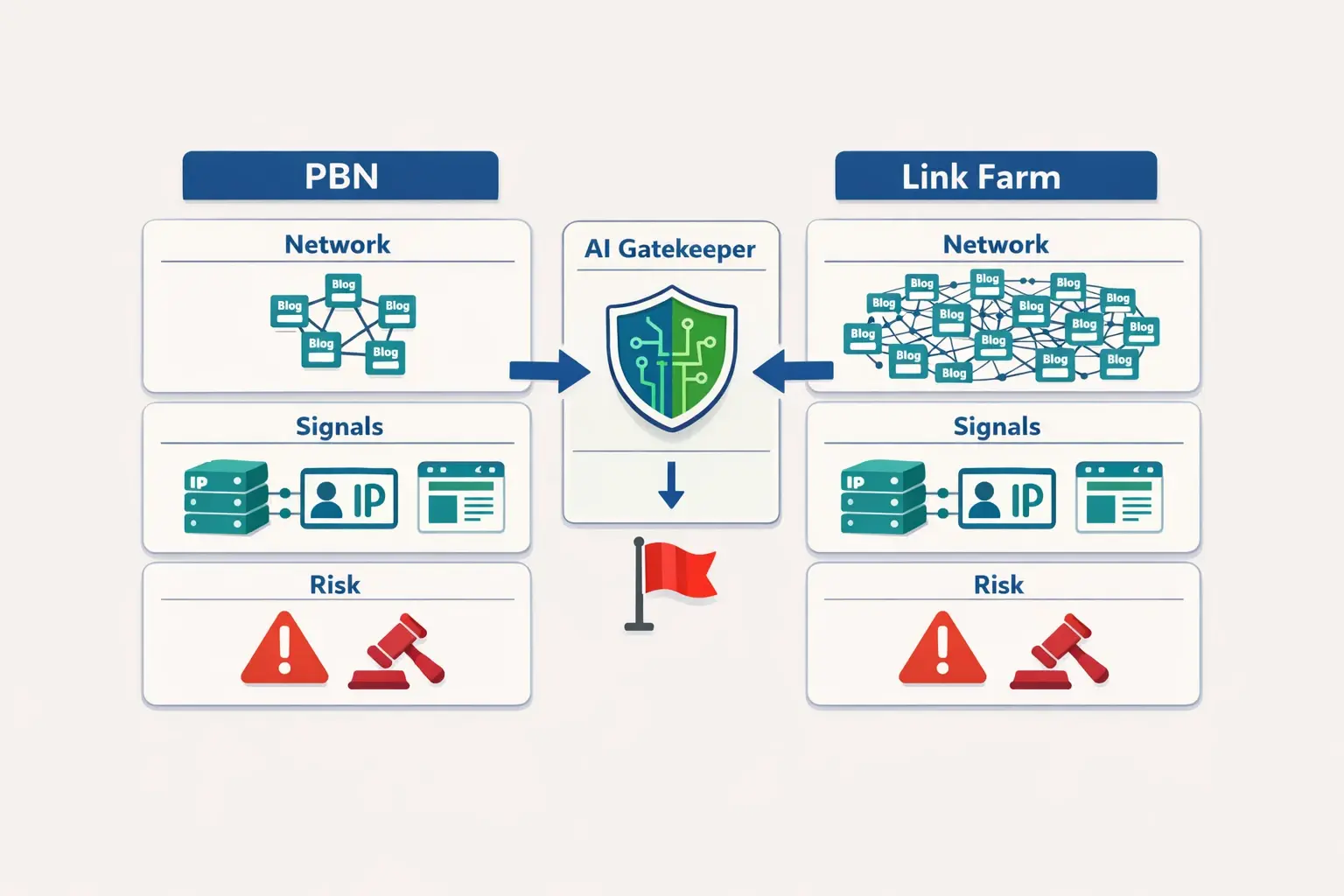 A quick visual definition: PBNs tend to be tightly controlled site clusters, while link farms look like dense link meshes. AI vetting systems use repeatable technical and content footprints to assign risk.
Before diving into the algorithms, we need to clarify what these AI systems are actually hunting.
Private Blog Networks (PBNs) are clusters of websites created specifically to artificially inflate the search engine rankings of a single "money site." Historically, these were built on expired domains that still held some residual authority.
Link Farms, on the other hand, are dense webs of highly connected websites that exist solely to link to one another or to sell links to outsiders. They are the digital equivalent of a massive, noisy billboard in an abandoned parking lot.
In the past, avoiding link building mistakes meant manually checking a site's Domain Authority and hoping for the best. Human reviewers at search engines would occasionally penalize these networks, but it was a game of whack-a-mole. Today, systems like Google's SpamBrain utilize AI to map the entire internet's link structure, spotting these artificial clusters with mathematical precision.
To understand real-time spam vetting, you have to look at how AI processes information. Machine learning models don't look at a single link and say, "This is bad." Instead, they evaluate hundreds of link metrics simultaneously, looking for patterns that deviate from natural web behavior.
Modern search AI relies heavily on Graph Neural Networks. Imagine the internet as a giant web of interconnected nodes (websites) and edges (links). A GNN doesn't just look at Site A linking to Site B; it looks at the "neighborhood" of Site A. If Site A is surrounded by thousands of low-quality sites, that "toxic neighborhood" score gets passed along the graph. AI maps the topology of a network to spot unnatural clusters instantly.
AI spam detection uses a blend of learning models:
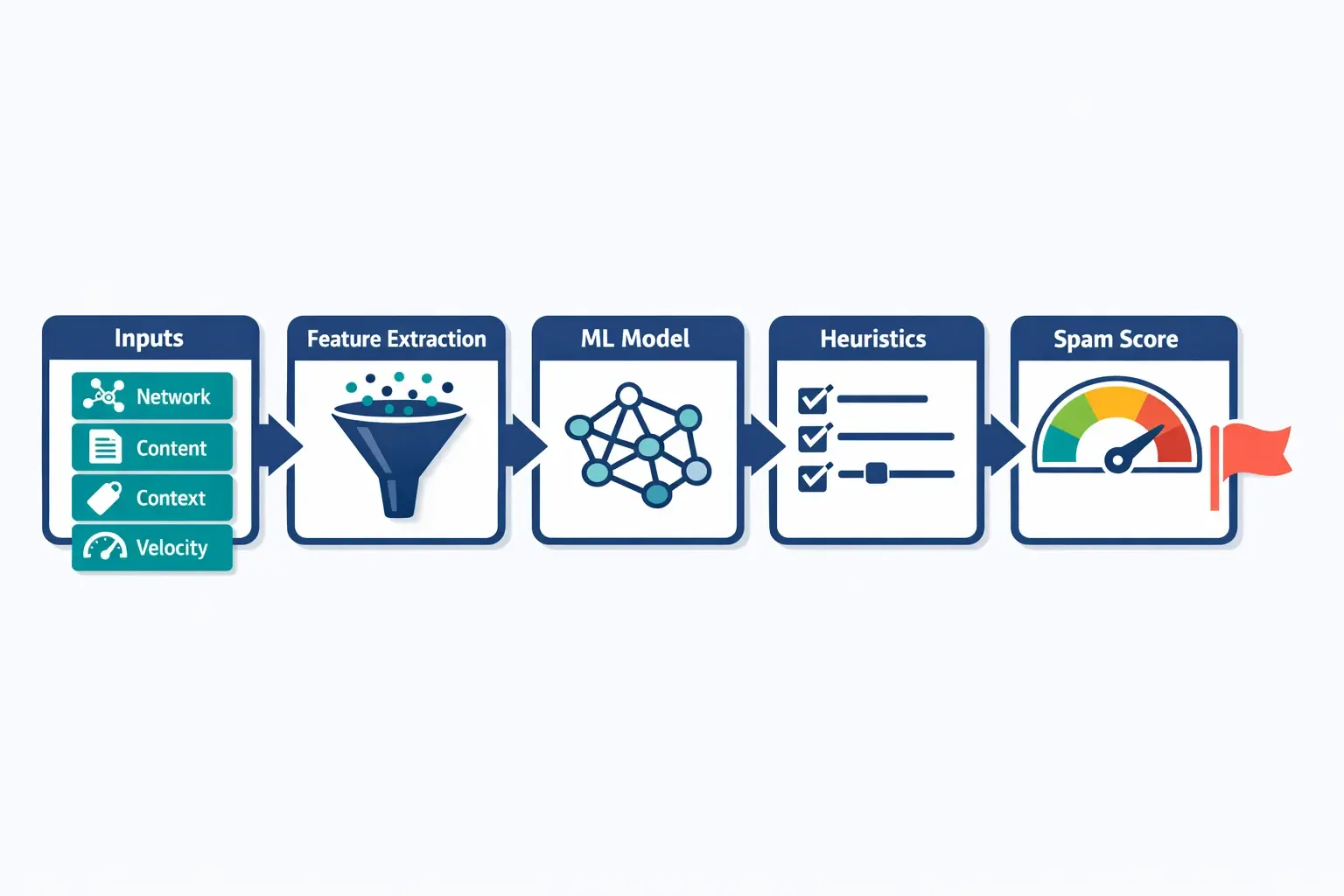 Real-time vetting typically blends machine learning with rule-based checks. Multiple link signals are transformed into features, evaluated, then summarized as a single risk score for fast decisions.
One of the most significant shifts we've seen leading into 2026 is the transition from periodic updates to real-time evaluation.
Historically, webmasters would wait in terror for massive, named algorithm updates (like the old Penguin updates) to roll out every few months. If you got caught in a link farm, you'd be penalized, and you couldn't recover until the next update ran.
Today's algorithmic vetting operates on streaming signals.
When a new link is discovered, the AI instantly assesses its spam probability score. If you use a cheap automated link building service that blasts your site with hundreds of forum profile links, the AI doesn't wait for a core update to devalue them. It neutralizes their impact in real-time. Sudden, unnatural spikes in link velocity are immediately flagged and throttled by these real-time systems, preventing toxic link acquisition from manipulating live search results.
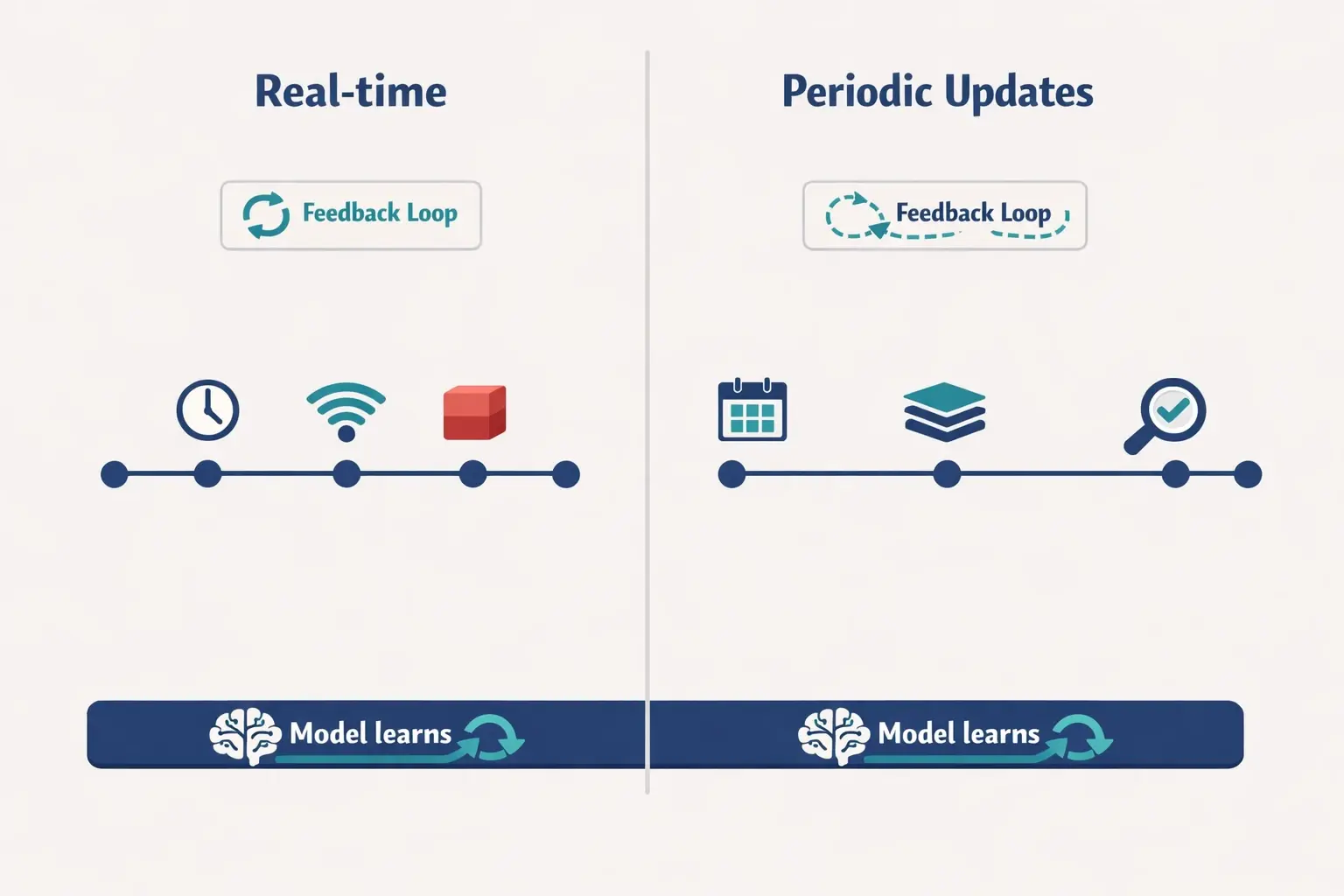 Real-time systems act on streaming signals and can interrupt toxic link acquisition quickly. Periodic updates typically evaluate in batches, with slower feedback but broader recalibration over time.
How does AI actually know a site is part of a PBN or link farm? It looks for interconnected footprints across three distinct layers.
AI systems are ruthless at identifying lazy infrastructure. They look for shared IP addresses, identical DNS configurations, matching Google Analytics or AdSense tracking codes, and domains registered by the same entity on the same day. While black-hat SEOs try to mask these, sophisticated AI cross-references technical data points much faster than a human ever could.
The question of does ai content rank in google is highly nuanced. AI content can rank if it provides unique value. However, link farms often use low-tier generative AI to spin hundreds of nonsensical, topically irrelevant articles just to hold a backlink. AI vetting systems use Natural Language Processing (NLP) to detect thin, repetitive, or logically disjointed content, immediately flagging the site as a potential link farm.
A natural link profile is messy. It contains brand mentions, naked URLs, and links from a wide variety of domains. AI detects manipulation by looking at ratios. If 80% of your incoming links use exact-match commercial anchor text (e.g., "best plumbers in london"), or if your site has zero outgoing links to authoritative external sources, the AI flags your profile as highly improbable in nature.
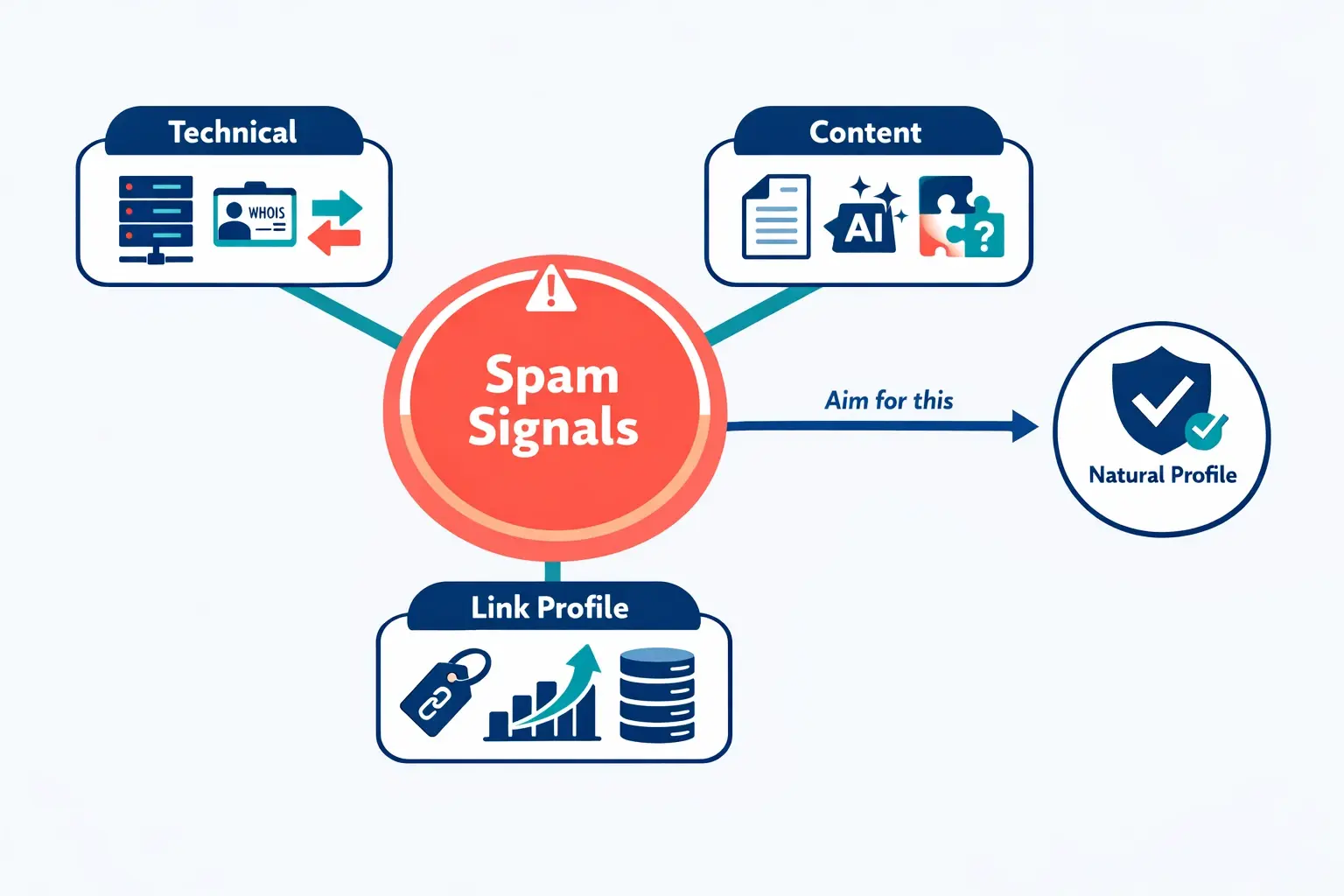 AI detection rarely relies on one footprint. It aggregates technical reuse, low-quality or mismatched content, and unnatural link patterns—then contrasts them with what a diverse, natural profile looks like.
As we shift heavily toward AI Answer Engines (like Google's AI Overviews and independent platforms), the goal of off-page SEO is transforming. We are moving from traditional "link building" to "generative engine optimization" and building "Entity Authority."
Modern AI engines don't just want links; they want citations they can trust to synthesize answers. To align with this, forward-thinking professionals have adopted what industry experts call the CITABLE mindset for vetting link opportunities:
Aligning your strategy with a rigorous link building checklist based on these principles ensures that your links are not just algorithm-safe today, but heavily weighted by AI engines tomorrow.
If you're wondering whether your current backlink profile would survive a real-time algorithmic audit, it's time to take proactive steps:
A manual penalty occurs when a human reviewer at a search engine reviews your site and determines you violate their guidelines. An algorithmic penalty happens automatically when AI systems (like SpamBrain) detect unnatural patterns. In 2026, the vast majority of link-related ranking drops are algorithmic and happen in real-time.
While rare, "false positives" can happen if a legitimate network of sites (e.g., a parent company owning several distinct brand websites) heavily cross-links using exact-match anchors on identical server architecture. This is why diversifying your technical setup and ensuring clear, distinct value for every site is crucial.
With the advancement of real-time AI vetting, search engines are increasingly adept at simply ignoring and devaluing spam links rather than penalizing the target site directly (unless you actively built them). However, if you have a history of engaging with link farms, conducting a thorough audit is still highly recommended.
AI does not penalize agency involvement; it penalizes low-quality execution. A reputable provider executing high-quality, bespoke link building for seo agencies using strict quality assurance checklists (verifying traffic, editorial standards, and relevance) builds profiles that AI systems view as entirely natural and highly authoritative.
The algorithms governing search have never been smarter, but that doesn't mean building authority has to be harder. It simply means the rules of engagement have shifted. By understanding that AI is looking for mathematical anomalies, lazy technical footprints, and low-quality content, you can deliberately build an off-page strategy that works with the algorithm rather than trying to outsmart it.
The most successful websites in 2026 aren't the ones finding new loopholes; they are the ones building verifiable entity authority through exceptional content and genuine relationships. Start by evaluating the true quality of your backlink profile today, and shift your focus toward earning citations that any AI model would be proud to reference.

